
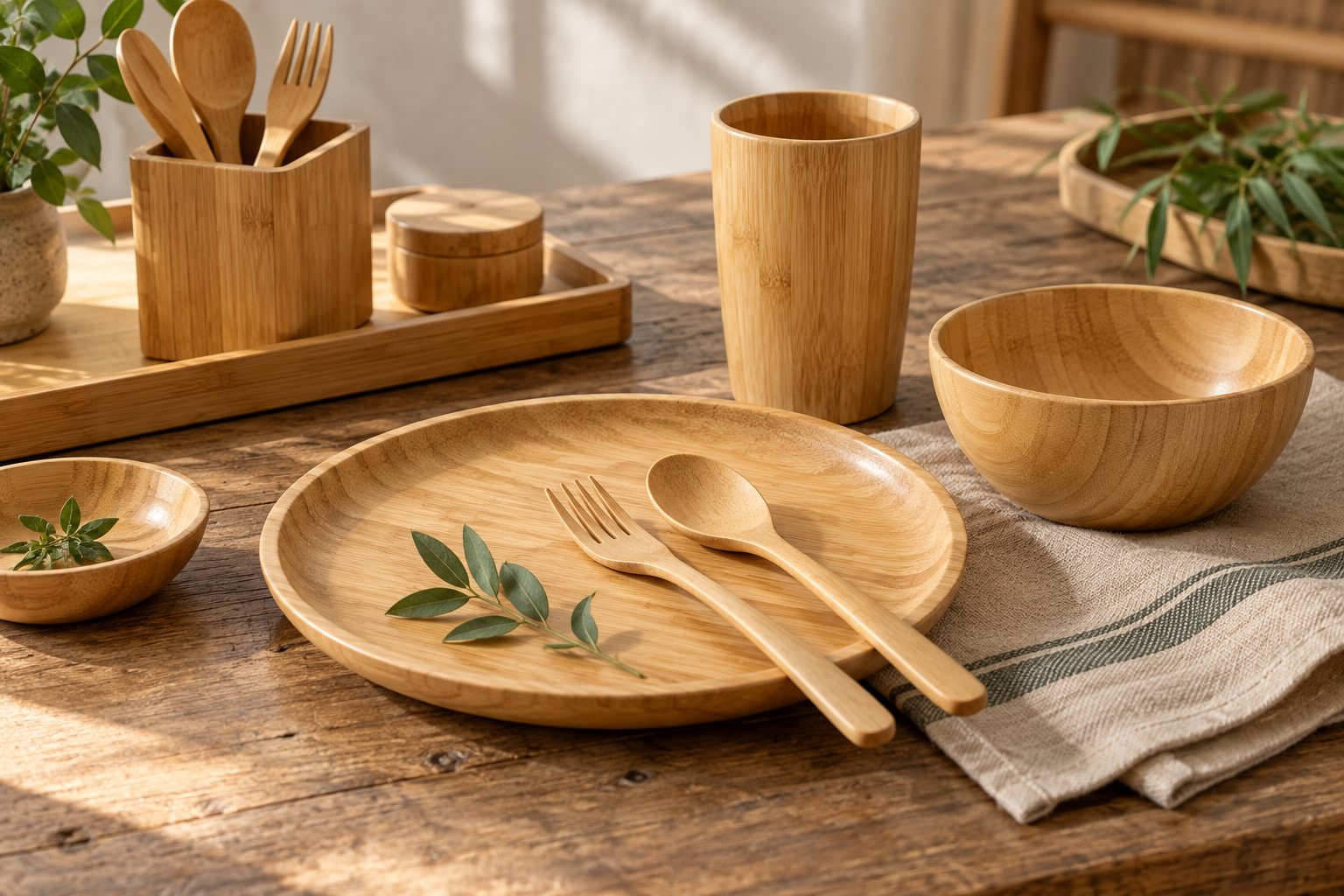
What durable bamboo dinnerware covers
Three piece families do most of the work in a dinnerware program: dinner and side plates, bowls from small sauce depths up to serving sizes, and divided plates where the compartments carry the design, most often in kids' ranges. Hospitality tends to buy open pieces to replace and extend; retail tends to buy coordinated sets. Same catalog, two reading habits, and the workshop plans them differently, which is why the desk asks about your channel before it asks about diameters.
Material logic comes before shape, because it decides weight, tone and the care promise you can print on the pack. The next two sections separate what buyers often blur together.
Whole pieces versus laminated panels
Bamboo turns into flat tableware two ways. Whole-culm pieces are shaped from a section of the stalk; this suits smaller formats and pieces with curvature. Larger flat plates and tray-like forms are laminated: bamboo strips pressed into panels with adhesive, then molded, sanded and finished. Laminated construction is the industry-standard way to reach stable flat ware, and it is not a secret ingredient; it is a spec line. The adhesive system is named on the spec sheet, and its food-contact documentation travels with the quotation, because that is the single line your compliance file and the physical product both depend on.
The split also matters when you scan a supplier catalog. The word bamboo alone does not tell you whether a plate is a shaped culm section or a pressed panel, and both can be honest bamboo. What cannot pass as bamboo is the third material in this market, covered near the end of this page.
| Piece | Typical construction | Program notes |
|---|---|---|
| Dinner and side plates | Laminated panel, pressed or molded to shape | Diameters as common options, confirmed on the spec sheet |
| Bowls | Shaped and laminated; depth set per program | Sauce, cereal and serve depths planned as separate styles |
| Divided plates | Panel with formed compartments | Kids' versions route through CPSIA planning |
Heat and care: promise only what the spec covers
Standard practice across durable natural-fiber ware: hand wash and dry, no dishwasher, no microwave, no long soaking, occasional re-oiling for oiled finishes. Those lines go on the care card and in the product description, and the spec sheet is what the program honors when a customer asks harder questions. Hot food on the table is a normal use case; oven, microwave and dishwasher are different questions that only the spec sheet answers, per program.
Some workshops can propose finish systems aimed at better wash tolerance, and hospitality buyers often ask. That is a legitimate request and a documented one: the capability and the papers behind it are confirmed in writing, never assumed from how a sample survives its first week. The day-to-day routine, including how to bring back tone with oil, is laid out in the buyer note on caring for durable bamboo dinnerware.
Outdoor, picnic and hospitality use
Bamboo dinnerware earns its place outdoors as much as on the table: lighter to carry than ceramic, quieter on hard surfaces, warmer in the hand than plastic. Picnic programs, glamping operators, hotel breakfast service and garden cafes order plates and bowls on this logic, usually in open stock rather than sets. The channel patterns and pack formats behind those orders are laid out in the buyer note on outdoor and picnic bamboo dinnerware, and the same pieces reappear in foodservice briefs with different care expectations, so state the channel in the brief.
Sets and set composition
Retail asks for coordinated sets: a plate and bowl pairing as the core, some programs adding a serving piece or a divided plate for children. Each configuration counts as its own style, and durable styles typically run 500-1,000 pieces per style as a reference range, confirmed in writing for the program on the MOQ and lead time page. What belongs in a set, and in what order a line should grow, is worked through in the buyer note on bamboo dinnerware set composition, so the first order is planned rather than guessed.
Tone matching across a set is worth a spec line of its own: plates, bowls and serving pieces pressed in the same batch read as one design, while pieces sourced apart can drift in shade. The desk batches tone-critical pieces together where the program allows and notes the expectation on the spec sheet, so the set on the shelf looks assembled by one hand.
The look-alike to rule out
A significant share of products sold as bamboo-fiber dinnerware are melamine-formaldehyde resin filled with bamboo powder: a composite, not bamboo. Germany's Federal Institute for Risk Assessment advises against using such composite tableware with hot foods and drinks, and the EU has restricted bamboo-melamine composites in food contact. This desk does not quote composite items as bamboo. Material systems are named on every spec sheet, and the buyer checklist, including the questions to put to any supplier, lives on the bamboo dinnerware safety page.
How a dinnerware program moves
The path is the usual one: brief, sample, spec sheet, production. Stock samples typically ship within days and custom samples in about 7-15 working days; bulk production typically takes 30-45 days after sample approval; every figure confirmed in writing per program. Before packing, pieces pass checks for smoothness, moisture and cracks, described on the quality control page. Kids' divided programs add the CPSIA planning track covered on the kids' bamboo tableware page. When the pieces and the care line are decided, send the brief to the desk and the reply comes back with a route, a sampling plan and the open questions in writing.