
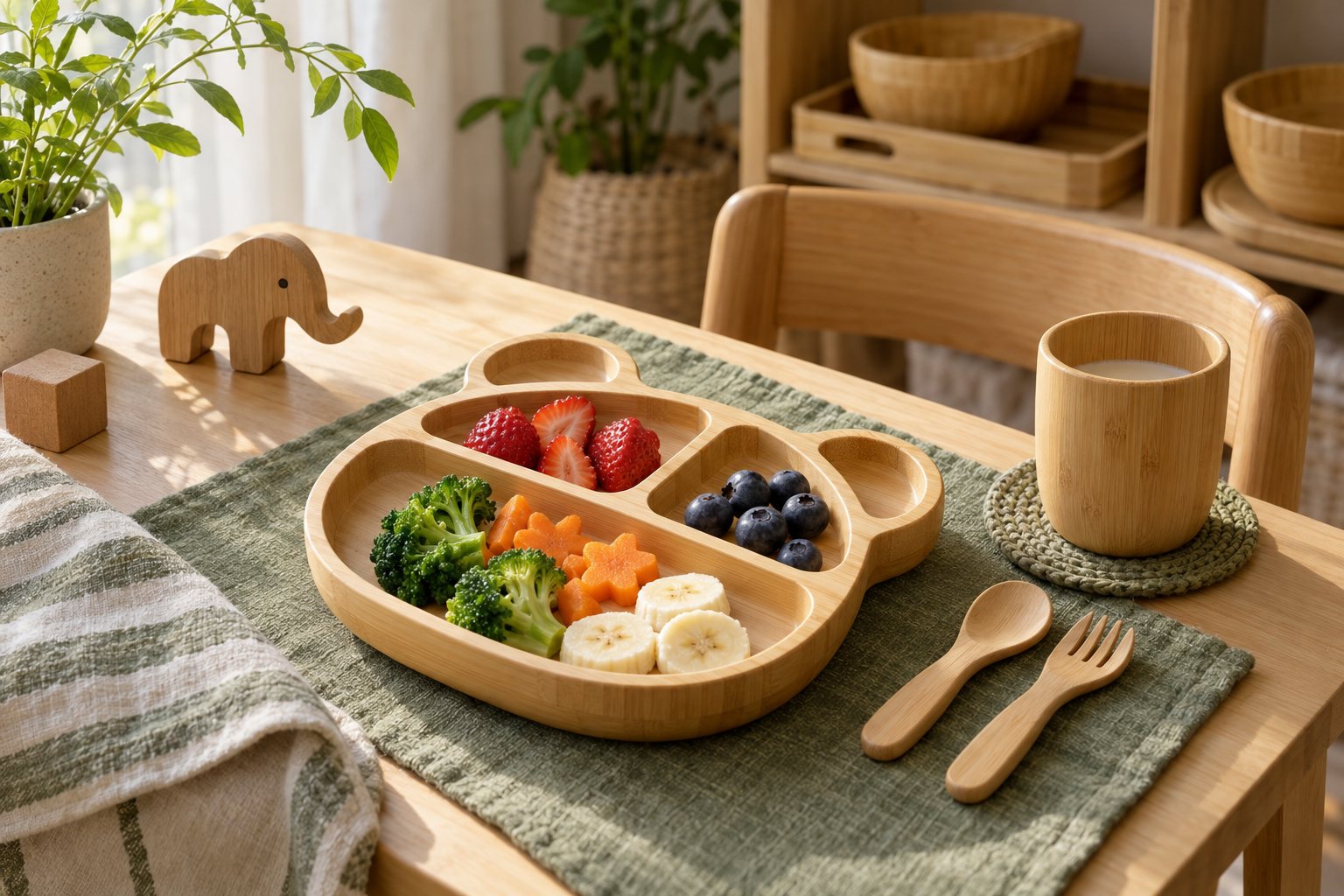
What a kids' line actually contains
Retailers and gift buyers usually build the category from three structures: a divided plate that keeps foods separate for selective eaters, a bowl-and-spoon set for first foods and cereals, and a small plate set scaled to little portions. Around those, programs add cups, snack bowls or a bundled mealtime set in a printed box. The shapes are simple; what separates a reorderable kids' line from a one-season experiment is everything printed on the spec sheet.
Durable bamboo ware for children is shaped and finished like the rest of the durable line — strips or panels shaped, sanded through finer grits, finished with a food-contact oil — but sized and detailed for small hands: rounded edges, shallower bowls, lighter pieces. Division walls on plates are shaped rather than glued-on in the programs we prefer to quote, because fewer parts means fewer questions later.
The material question comes first
Bamboo is not one material on a spec sheet. Whole bamboo is cut and shaped from the culm. Laminated bamboo is strips pressed with adhesive into flat panels — standard for plates and trays, and perfectly quotable when the adhesive system is identified and documented. What this desk does not quote as bamboo is bamboo-melamine composite: melamine-formaldehyde resin filled with bamboo powder, often marketed as "bamboo fiber" tableware. That category carries real regulatory history — Germany's Federal Institute for Risk Assessment (BfR) warns against using such items with hot foods and drinks, the EU has banned bamboo-melamine composites from food contact, and FDA publishes melamine tableware guidance. A kids' item is the worst possible place to discover your "bamboo" plate was a resin composite.
So the first document in a kids' program is a material declaration: what the plate is made of, named precisely, signed by the workshop. Our bamboo dinnerware safety page explains how to tell the materials apart and what the declaration should say; the durable-line overview at bamboo dinnerware shows where kids' sets sit in a broader range.
CPSIA duties, in plain terms
Tableware marketed to children aged 12 and under is a children's product under the CPSIA in the United States. In practice that means three things the importer of record owns:
- Third-party testing for the applicable rules, performed by a CPSC-accepted laboratory.
- A Children's Product Certificate that identifies the product, the rules it was tested against and the importer.
- Tracking labels on the product, marking it in a way that ties it to its production run.
The testing scope and current limits are exactly the kind of detail that moves, so we scope the program with you and you confirm the current requirements with a compliance adviser before committing a launch date. What we control on the desk side is readiness: the material declaration, the adhesive and finish documentation, and the workshop information a lab or adviser will ask for are assembled into the program file before samples ship, not after.
Design questions to settle before quoting
Kids' programs accumulate small decisions that behave like big ones at production time. The list we work through before a quotation:
- Suction bases. Some programs want suction-base bowls; whether it is available, how it attaches and what it does to testing depends on the workshop, so it is asked and confirmed per program rather than assumed.
- Engraving versus print. A bunny face can be laser-engraved or printed; engraving survives use and needs no ink documentation, print opens a branding surface that needs its own papers.
- Packaging. A printed gift box sells the set and adds its own material and claim questions.
- Care copy. The honest default for natural-fiber ware is hand wash and dry, not dishwasher and not microwave, unless the specific program's spec says otherwise — confirm per program.
None of these are exotic. They are just decisions that get expensive when they are discovered late, which is why the desk asks them at the brief stage.
The spec-sheet checklist
| Ask for | Why it matters |
|---|---|
| Material declaration naming whole or laminated bamboo | Separates real bamboo from bamboo-melamine composite before anything is quoted |
| Adhesive system documentation for laminated panels | Lamination is standard practice; the adhesive system falls under FDA food-contact rules and needs its papers |
| Finish identification | Food-contact oil or no finish, named on the sheet, consistent with the retail story |
| Testing plan and certificate path | CPSIA testing at a CPSC-accepted lab, the resulting Children's Product Certificate and tracking labels |
| Tracking label artwork | Printed or engraved identifiers tied to the production run, agreed before mass production |
A program that arrives with these five rows filled can move from sample to shelf without a compliance surprise. A program that treats them as later details usually meets them again at the worst possible moment — an audit, a retailer onboarding form or a customer question in public.
Sizing, staging and the gift opportunity
Kids' lines sell by stage as much as by piece. A first-foods stage centers on the bowl-and-spoon set and a shallow bowl; a toddler stage adds the divided plate and a first open cup; a preschool stage approaches full-size pieces with playful engraving. Programs staged this way build a natural ladder for repeat purchases, and the same workshops tool pieces across stages, so a line can grow one stage per season instead of launching everything at once.
The category is also a gifting workhorse. A boxed bowl-and-spoon set with an engraved name is the kind of item gift buyers reorder on autopilot, and the gift box is where a program earns its shelf presence: printed board, window or none, care copy inside the lid. Gift packaging is quoted with the program because it changes case counts and adds its own material paperwork.
Quantities and how to start
Durable kids' items follow the durable-line pattern: typically 500-1,000 pieces per style as a reference range, higher for custom shapes, gift boxes or printed branding, all confirmed in writing per program. Stock samples typically ship within days; custom samples with engraving or packaging run about 7-15 working days; bulk production typically 30-45 days after sample approval. Start by sending the brief with your set list and market, and read the kids' CPSIA note plus the care guide before your packaging copy is drafted.