
One category, two different businesses
Bamboo products look like one category from the outside and behave like two from the inside. A case of disposable bamboo cutlery for a foodservice distributor and a boxed bamboo tableware set for a retail shelf share a raw material and almost nothing else: different workshops, different paperwork, different order sizes, different ways of going wrong. Buyers who treat them as a single product line usually discover this mid-program, when a quotation arrives carrying assumptions that do not match their channel.
Canegrove is a sourcing desk, not a factory. We coordinate verified partner workshops across China's bamboo processing belts, and we split every program into one of two routes before any quotation is written. This page is the map: what each route covers, which product lines belong to it, and where to read the detail. If you already know your channel, the fastest path is still five minutes here, because the route choice drives the papers you will need.
Route one: compostable disposables
The disposable route serves foodservice distributors, restaurants and caterers, event and wedding suppliers, and takeout programs. Items are made to be used once and composted where facilities exist: forks, knives, spoons and sporks; tasting spoons; straws and stirrers; skewers; bamboo plates in several diameters; napkin-wrapped cutlery kits; and case packs sized for back-of-house counting. The buying language on this route is cases per month, certificate references and unit counts, not shelf appeal.
Compostability here is a paperwork property, not an adjective. Claims tied to ASTM D6400, EN 13432 or BPI certification belong to specific products from specific producers, and they are verified through each scheme's public lookup. We quote against certificate references that check out, and those references are written into your program file. The compostable disposables line page covers items, channels and case-pack logic in full.
Route two: durable bamboo ware
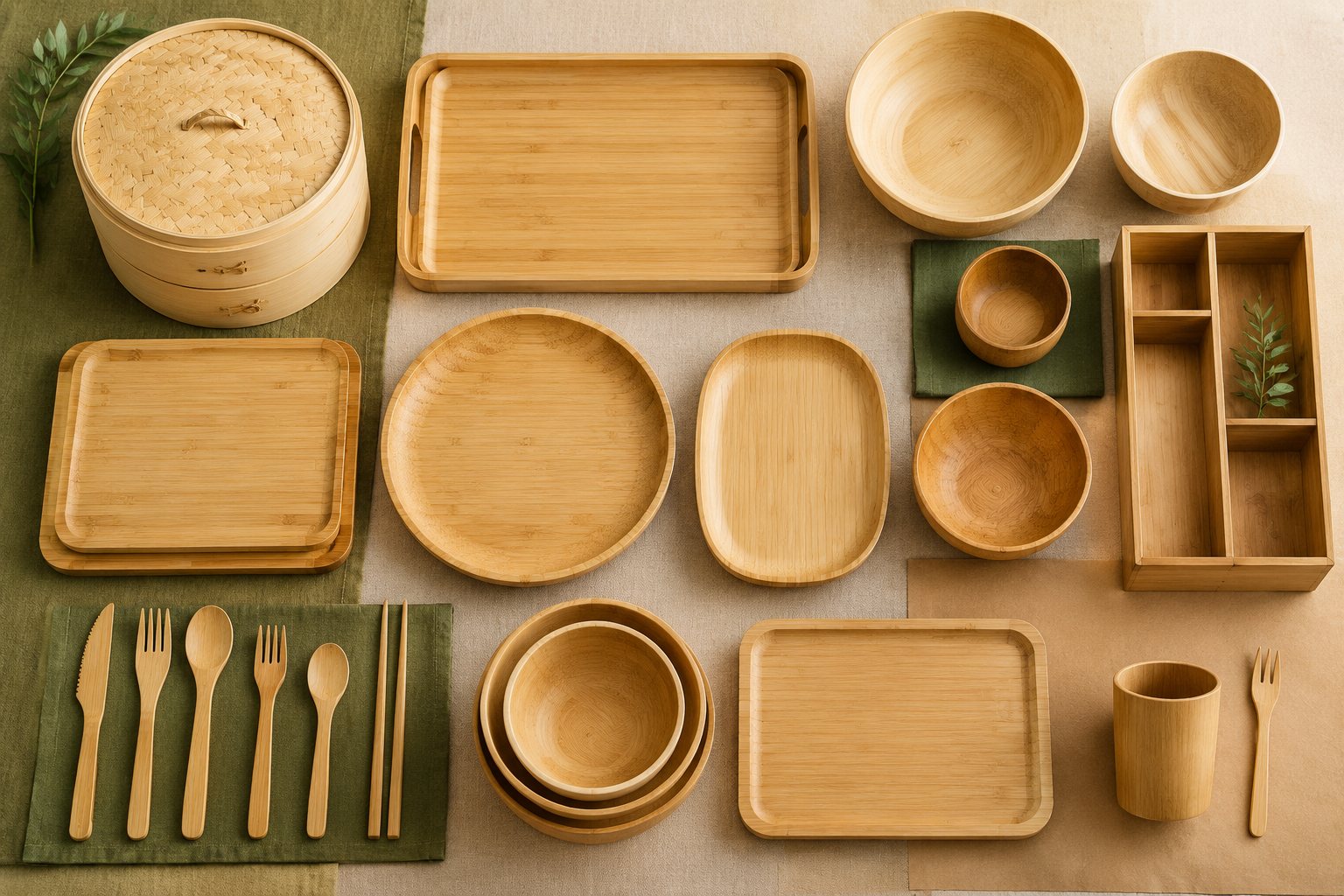
The durable route serves boutique retailers, eco brands, corporate gift buyers and e-commerce sellers. Items are made to be washed and kept: cutlery sets with travel pouches, dinner plates and bowls, divided plates for children, trays and platters, cutting and serving boards, drawer organizers and countertop crocks, kids' tableware sets, and tea and coffee accessories such as steamers, coasters and trivets. The buying language changes accordingly: finishes and adhesives, care cards, branding methods, packaging and shelf presentation.
Materials split again inside this route. Whole bamboo, cut and shaped, suits cutlery and boards; laminated bamboo, strips pressed with adhesive, suits flat and pressed items. The adhesive system is a specification line with documentation attached, not a footnote. The durable bamboo ware line page covers finishes, branding and the adhesive question.
The full line list
| Line | Route | Typical buyers | Guide |
|---|---|---|---|
| Forks, knives, spoons, sporks, tasting spoons | Compostable disposables | Foodservice distributors, takeout | Disposable cutlery |
| Bamboo plates in several diameters | Compostable disposables | Caterers, event suppliers | Disposable dinnerware |
| Straws, stirrers, skewers | Compostable disposables | Bars, restaurants, concessions | Compostable line |
| Cutlery sets with travel pouch | Durable bamboo ware | Eco brands, corporate gifts | Cutlery sets |
| Dinner plates, bowls, divided kids' plates | Durable bamboo ware | Retailers, e-commerce sellers | Bamboo dinnerware |
| Trays, platters, cutting and serving boards | Durable bamboo ware | Boutique retail, gift programs | Serveware |
| Drawer organizers, countertop crocks | Durable bamboo ware | Kitchen retailers | Organizers |
| Steamers, coasters, trivets | Durable bamboo ware | Tea and coffee retail | Tableware hub |
Lines are not silos. Plenty of buyers run one of each route and coordinate reorders on the same calendar, because the two routes share material supply and often share a shipment. The wholesale buying guide walks through how the routes differ in practice for a mixed buyer.
What buyers order first
First-program patterns repeat across channels. Foodservice distributors usually start with a fork-and-spoon case pack and add wrapped kits once the certificate paperwork is settled. Eco brands usually start with a cutlery set in a pouch, because it carries a laser-engraved logo well and ships small enough for a first landing. Retailers adding a bamboo corner to an existing kitchen wall usually start with boards and organizers, which need the least claims discipline. Wedding suppliers start with a napkin-wrapped kit and a matching plate, sold as a bundle. None of these are rules; all of them are cheaper first programs than opening with a fully custom shape.
How the desk coordinates a program
Every program runs the same spine, whichever route it takes. You send a brief stating items, channel, expected quantities and any claims the packaging must make. We match the brief against partner workshop profiles, request stock or custom samples, and put the specification, reference MOQ, lead time and any certificate references in writing. After sample approval a golden sample is fixed, production runs against it, and inspection reports return to you alongside the shipment papers. Each stage has its own page under the capability section of this site, so you can read the part you are about to buy before you buy it.
Numbers, honestly framed
Order sizes and timing are published as reference ranges and confirmed in writing for each program: disposable items typically from about 1,000 pieces per item, durable ware typically 500 to 1,000 pieces per style, bulk production typically 30 to 45 days after sample approval. Prices never appear as fixed figures; they are quoted per program because route, item, branding and certification needs all move them. The MOQ and lead time page lists the levers in detail.
If you know your channel but not your opening item, send a brief describing the use case and rough annual volume. We will come back with a route recommendation and two or three concrete starting programs, each with the papers it needs named up front.