
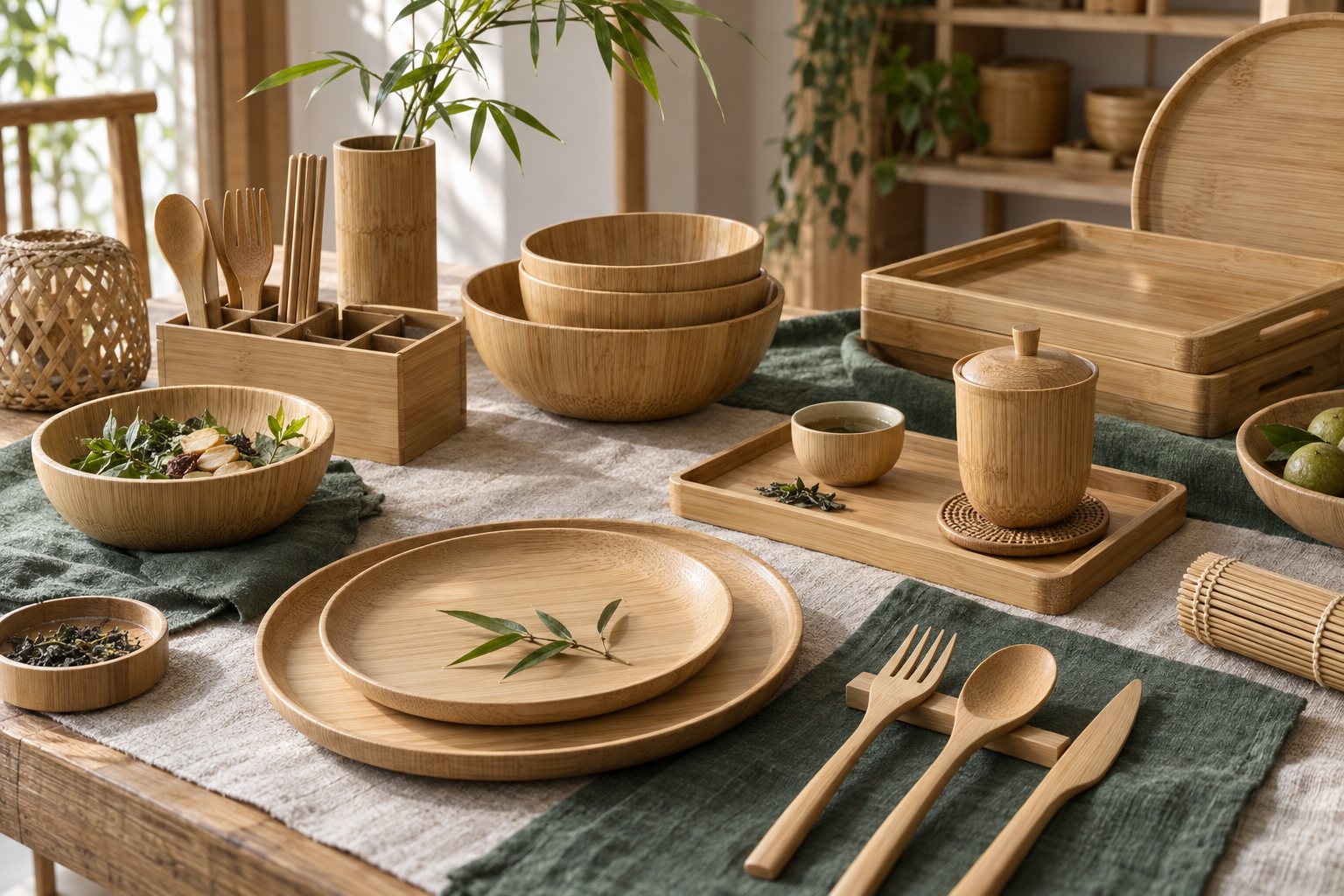
An umbrella word, four working tiers
Retail buyers, foodservice buyers and gift buyers all say bamboo tableware and mean different shelves. To keep briefs sharp, this desk sorts the category into four tiers. The split is not academic: each tier has its own buyer, its own care story and its own reorder rhythm, and a program that mixes them without noticing ends up with one product page contradicting another.
| Tier | Typical pieces | Usual buyer |
|---|---|---|
| Everyday dining | Plates, bowls, divided plates | Retail brands, hospitality open stock |
| Serving pieces | Trays, platters, boards | Boutiques, caterers, hotels |
| Tea and coffee | Steamers, coasters, trivets | Tea brands, gift programs |
| Adjacent categories | Organizers, kids' sets, travel sets | Retailers extending a range |
The tiers also map to how workshops quote. Everyday pieces run on molding and finishing lines; serving pieces run on panel lines; tea accessories mix shaping and fitting work. A brief that names the tiers lets the desk route pieces to the right workshops in one pass, instead of discovering mid-quotation that a coaster and a dinner plate share nothing but a word.
Everyday dining pieces
Plates and bowls carry the weight of the line: they are the pieces customers use daily and judge on feel. Construction is either whole-culm shaping or laminated panels, with the adhesive question documented per item, and the care promise follows the finish. The full treatment lives on the bamboo dinnerware page; for planning purposes, treat this tier as the anchor and let the other tiers attach to it rather than float free.
Open stock versus sets is the second question in this tier. Hospitality buyers replace pieces individually and want stable styles year over year, so a style retired early becomes a service problem for them. Retail buys coordinated sets and wants freshness each season. The two demands can share a workshop but not always a style list, and the desk keeps the two catalogs separate so a hotel's replacement order never forces a retail line to freeze.
Serving pieces
Trays, platters and boards are the touch-me tier: shoppers pick them up, and they sell a table story even to people who came in for bowls. They also carry hospitality programs, where stacking, rotation and replacement cadence matter as much as looks. Construction is mostly laminated panels, sizes run as common options confirmed on the spec sheet, and the detail sits on the bamboo serveware page.
Tea and coffee accessories
Steamers, coasters and trivets are small, giftable and repeat-friendly, which makes them the natural second tier for a brand that started with cutlery or plates. Steamers have their own technique and care rhythm, since steam service is hard use; coasters and trivets live near heat and water by definition, so the finish question is not optional. The buyer note on bamboo steamers and tea accessories covers the shapes and the programs that move them.
Gift and seasonal tiers
Coasters, trivets and small boards are the tier that carries gifting seasons, and boxed sets built around them give a brand a second calendar: not the dinner season but the holiday one. Corporate programs behave the same way, with engraving doing the personalization work. Because the pieces are small, the per-style quantity decision is gentler, but the branding bar is higher: small surfaces forgive nothing, so artwork is approved at actual size before sampling, not imagined on a screen.
Brand-fit logic: three tests before a piece joins the line
First, the use-moment test: the piece should share a table, a kitchen or a drawer with something the line already sells. Second, the care-story test: if it cannot share the care card, it does not belong on the same shelf, because mixed instructions read as nobody thought it through. Third, the claims test: every piece must survive the same claims discipline, since one loose compostability line can taint a whole page of honest products. These tests are quick, and they prevent the assortment sprawl that the buyer note on assortment planning describes in detail.
Positioning tiers without a price list
Buyers often ask how the tiers stack commercially. The honest answer is that this desk quotes per program and publishes no prices, but the structure still exists: everyday pieces anchor the opening offer, serving pieces lift the ticket, and gift-tier pieces carry seasonality and margin. Planning the line with those three roles in mind keeps the assortment honest, and it stops a brand from asking one piece to do three jobs at once.
Material discipline across the line
Whatever the tier, the material rule is constant: whole or laminated bamboo, with adhesives and finishes named on the spec sheet and their food-contact papers attached. Bamboo-melamine composite stays outside the line; regulators in some markets warn against hot use of the composite, and this desk does not pass it off as bamboo. If a supplier proposes a composite item, it is quoted as the mixed material it is or not quoted. The background and the buyer checklist are on the bamboo dinnerware safety page.
One program, several categories
Mixing tiers in one program is normal and usually wise: a cutlery set opens the door, dinnerware builds the table, a coaster or trivet carries the gifting season. Because the partner workshops behind the tiers overlap, one spec discipline covers all of them, and one quotation can span categories with a reference MOQ per style, typically 500-1,000 pieces, confirmed in writing. The full catalog view is on the bamboo products overview, and when the tier list is decided, send the brief and the desk will map it to workshops and sampling.
Sequencing matters less than coherence: a brand that adds tiers in an unusual order but keeps one care story still reads as a line, while a brand that adds pieces in season without the three tests reads as a sale rack. The working advice is to decide the tier list once, hold it for at least two reorders, and let reorder data, not impulse, nominate the next addition.