
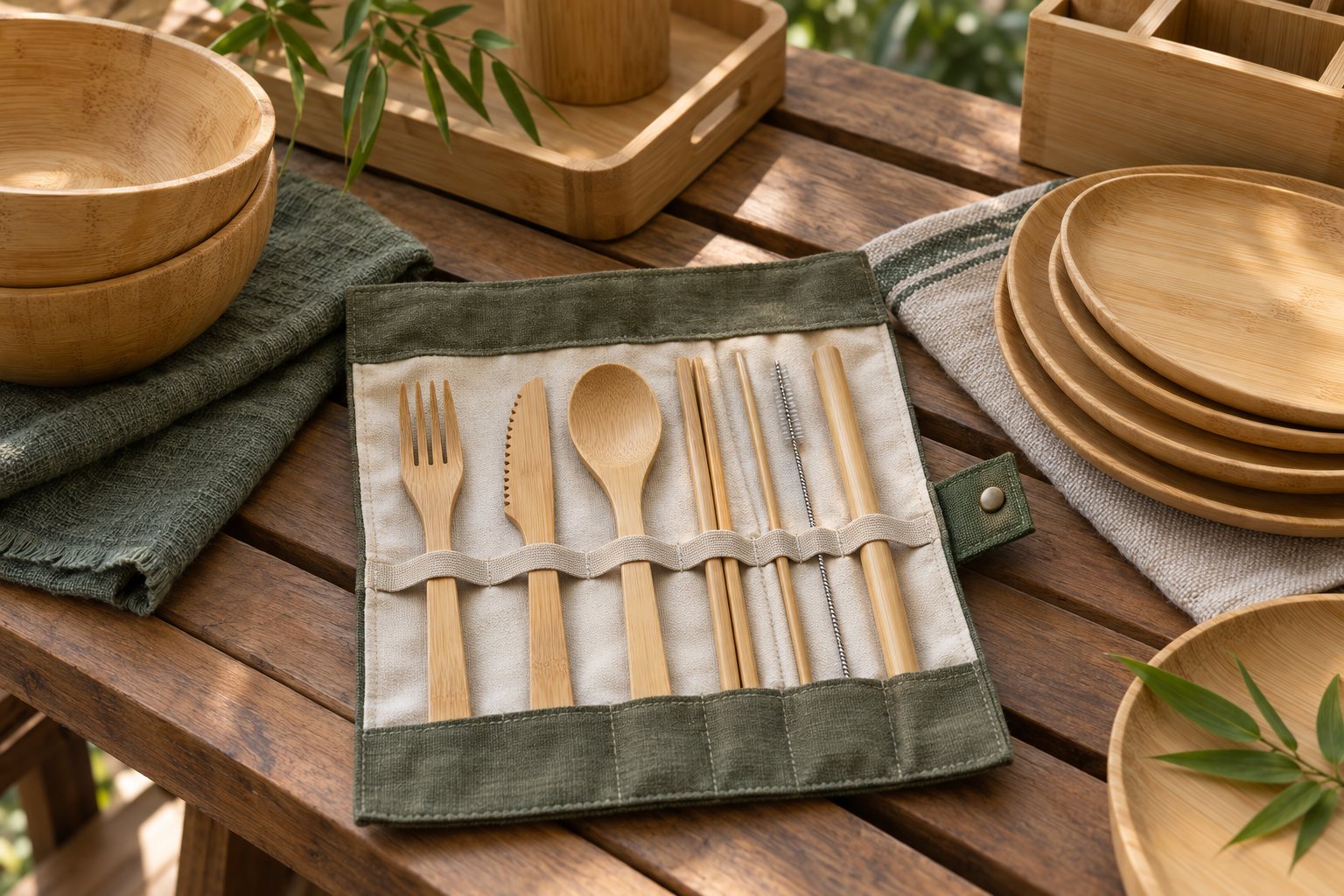
What ships in a travel set
A travel bamboo cutlery set is durable ware: full-size or slightly compacted pieces, sanded and finished for repeated use, packed in something a person actually carries. The core set list is a fork, a knife and a spoon, or a spork when the program wants one piece fewer; some workshops add chopsticks or a straw to the set list, and some include a small cleaning piece for straw or spork tines. The exact contents are agreed per program and written into the quotation, because the set list is what your packaging counts and what your unit cost is built on.
These sets belong to the durable line, not the disposable one — the pieces are washed and reused, which is the entire point of the purchase. That distinction matters for claims and care copy: repeated use, hand wash and dry, occasional re-oiling for oiled finishes. The bamboo cutlery sets hub shows where travel sets sit beside home sets and open-stock pieces.
Pouch formats: case, cotton, linen
The carrier is half the product. Three formats dominate the category, and each tells a different story on a retail shelf:
| Format | Character | Fits |
|---|---|---|
| Hard case | Structured, closes clean, protects the pieces in a bag | Outdoor retail, corporate gift programs |
| Cotton pouch | Soft roll or sleeve, natural look, generous print surface | Zero-waste shops, lifestyle e-commerce |
| Linen pouch | Slightly crisper texture and drape than cotton, popular for premium looks | Gift and boutique programs |
Cotton and linen pouches are the common options and the usual choice for zero-waste retail, because the pouch itself reads as part of the story rather than as packaging to discard. Case programs suit channels where the set lives in a backpack or a car. All three take branding: laser engraving on the pieces, screen print or woven labels on the pouch, agreed per program. Our private label page covers how branding rounds are scheduled and sampled.
The zero-waste retail channel
The natural buyers for this category are zero-waste and refill shops, outdoor and camping retailers, campus stores and corporate sustainability programs that gift a set to employees. What they share is a buyer who already owns a water bottle and is adding to a kit, so the set competes on completeness, feel and story rather than on novelty. Two merchandising notes from programs we have scoped: sets that include the cleaning piece generate fewer returns and questions, and programs that print care instructions on the pouch — wash, dry, re-oil — spend less time answering the same email.
For e-commerce sellers, the set photographs well flat or rolled, which keeps content costs down; the bamboo cutlery hub covers the pieces themselves, and the pouch category is compared in more detail in the cutlery pouch note.
Corporate and campus programs round out the channel: sustainability teams buy sets in hundreds for onboarding packs and events, usually with restrained engraving and a simple sleeve rather than retail cartons. These orders are quieter than retail but steadier, and they often start the reorder calendar that makes a travel program worth its tooling.
Airports and security: the honest note
Retail buyers ask, and travelers ask harder: can bamboo cutlery go through airport security? The honest answer is that rules differ by authority and by country, knife rules in particular are enforced differently across jurisdictions, and enforcement changes over time. Spoons and forks generally travel without comment; anything with a blade edge is the piece to think about. We do not publish a rulebook here — travelers should confirm current requirements with the relevant aviation authority before flying, and retailers should keep product copy descriptive rather than advisory. Our travel rules note collects the considerations for buyers writing product pages.
How a travel program runs, start to shelf
- Set list. Pieces, cleaner, pouch format — pinned before pricing.
- Sample round. Stock set plus your pouch; feel, weight and closure checked in hand.
- Branding round. Engraving files and pouch artwork sampled together, since scale differs.
- Written confirmation. MOQ, lead time, case pack and care copy fixed in the quotation.
- Production and packing. Sets assembled complete, so retail receives sellable units.
Two program notes earn their space here. First, completeness is a quality gate: a set that ships missing its cleaner generates the same customer email forever, so final packing checks count components per set. Second, the pouch is a quiet marketing surface — care instructions, a short material story, a reorder prompt — and buyers who use it well turn a utility purchase into a brand touchpoint. Neither habit adds noticeable cost; both save support hours that are easy to underestimate.
Program mechanics
Travel sets follow durable-line quantities: typically 500-1,000 sets per style as a reference range, higher when the pouch is custom-sewn or the branding round is involved, all confirmed in writing per program. Stock samples typically ship within days; custom pouch and engraving samples run about 7-15 working days; bulk production typically lands 30-45 days after sample approval. The set list, pouch material, branding method and care copy are the four lines that fix the quote — change one and the number moves, which is why we pin them before pricing.
If you are building a zero-waste range or a gift program around this category, send the brief with your set list, pouch preference and branding plan. For the desk-side story of where the material comes from, see the sourcing network; for the reusable-versus-disposable framing, read the channel comparison.