
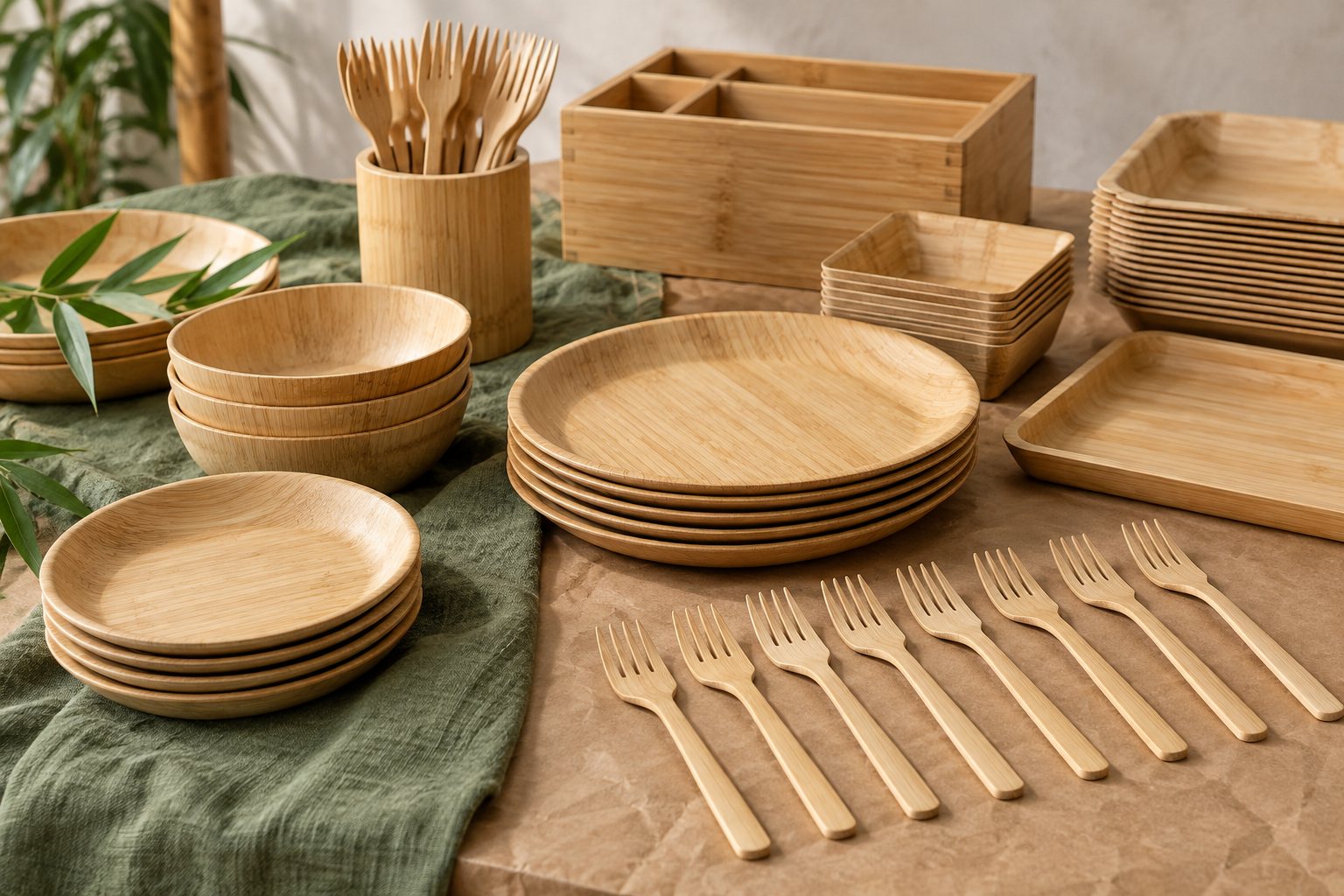
The item list, and what each piece is for
Disposable bamboo cutlery is a family of shapes cut and pressed from moso bamboo, sanded smooth, cleaned and packed for single-service use. Buyers usually meet the line through a short list of items:
- Forks, knives and spoons — the full-size trio that replaces a plastic set one-for-one in a takeout bag.
- Sporks — a combined piece that removes one SKU and one wrap from the kit.
- Tasting spoons — short spoons for samples, tasting counters, festivals and catering passes.
- Straws — cut bamboo tubes, cleaned and dried, sold in counted bundles.
- Stirrers — slim pieces for coffee service and bar programs.
- Skewers — pointed pieces for grilling lines, festivals and packaged food.
Each item is a separate SKU with its own tooling, its own pack count and — where a claim is needed — its own certificate question. A program that holds compostability paperwork on forks does not automatically hold it on straws. That is why we keep the item list explicit: the documents follow the item, not the category.
Napkin-wrapped kits: the unit most programs actually buy
Restaurants rarely order loose forks. The buying unit is the kit: a fork and knife, or a spork, wrapped with a napkin and sealed so a packer drops one unit per bag. Wrapping is also where programs customize — napkin print, a small label, ordering information — and where unit cost and packing speed are decided. Get the wrap wrong and every bag on the line slows down.
| Format | What it contains | Where it fits |
|---|---|---|
| Open bulk | Items counted into inner boxes, no wrap | Catering kitchens that plate or wrap themselves |
| Napkin-wrapped kit | Fork plus knife, or a spork, wrapped with a napkin | Takeout and delivery programs |
| Single-wrapped piece | One item, sealed on its own | Condiment stations, delivery add-ons |
| Case pack | Kits or pieces packed per case at a fixed count | Distributors and institutional store rooms |
Case counts are fixed per program and written on the quotation. When a distributor plans shelf or warehouse space around a carton, we confirm the count and the carton size in writing before production is scheduled. A mismatch discovered on the dock costs more than the email that would have prevented it.
Where the demand comes from
Four channels buy this line, and each buys differently:
- Takeout and delivery — the wrapped kit is the product; consistency and pack speed decide reorders.
- Catering and events — open bulk and tasting pieces, bought per event against dates that cannot slip.
- Institutions — case packs on schedule contracts, with documentation reviews that tend to be stricter than average.
- Retail and e-commerce sellers — counted packs for households, where branding carries the sale.
Tell us which channel leads the program and the scoping changes shape: a takeout account is quoted around kit format and repeat volume, an event calendar around delivery dates, an institution around papers and fixed case counts. The compostable disposables route page shows how this line sits beside plates and straws in one program.
Compostability as a document, not a mood
Most buyers arrive at this line for one reason: their customers ask what happens to the fork after lunch. The honest answer is procedural. Compostability is a property a specific product demonstrates through certification — BPI in North America, ASTM D6400 as the US standard specification, EN 13432 in Europe, and the TUV OK Compost family of marks. The certificate belongs to the product and its producer, it can be verified on the scheme's public lookup, and we quote it with its reference number or not at all.
In practice your packaging can say "made of bamboo" the day the cartons land, and it can speak about compostability only when the program's certificate documents are in the file and your claims review has cleared the wording. The FTC Green Guides expect qualification and substantiation, and loose eco language is a retailer audit waiting to happen. Where a compost facility or a state rule requires it, we also collect written PFAS-free confirmation, because grease-resistance treatment is the quiet variable in foodservice disposables. Our compliance page covers the claim rules in one sitting.
Quantities and timing, as reference ranges
Published ranges from compostable-cutlery makers put disposable bamboo cutlery typically from about 1,000 pieces per item, usually packed per case; custom shapes and printed wraps quote above stock levels. Stock samples typically ship within days, custom samples run about 7-15 working days, and bulk production typically lands 30-45 days after sample approval. Every figure here is a typical reference range confirmed in writing for each program — never a promise, never a price.
How we scope a disposable program
- Item list and format. Which pieces, wrapped or open, case count per item.
- Claims list. What the packaging must say, and which certificate papers back it.
- Match and quote. We match items and workshops, quote with certificate references attached, and confirm MOQ and lead time in writing.
- Sample and approve. Stock samples for format checks, custom samples for wraps and prints.
- Schedule and ship. Production booked against the approved sample, entry documents assembled for your broker.
If that sequence matches how you buy, send the program brief with your item list and channel. For the plates and bowls that sit beside the cutlery, continue to disposable bamboo dinnerware; for the side-by-side material argument, see bamboo versus plastic cutlery.