
Where the disposable route earns its keep
Disposable bamboo cutlery and dinnerware exist for the moments a dishwasher cannot reach: the takeout bag, the festival gate, the catering line, the cafeteria tray, the wedding table set between courses of an outdoor dinner. The buyer's problem in these channels is rarely whether bamboo works. It is whether the item, the case pack, the compostability paperwork and the program price per case all line up for one specific operation. This page covers the line itself and the papers that keep its claims defensible.
The item list
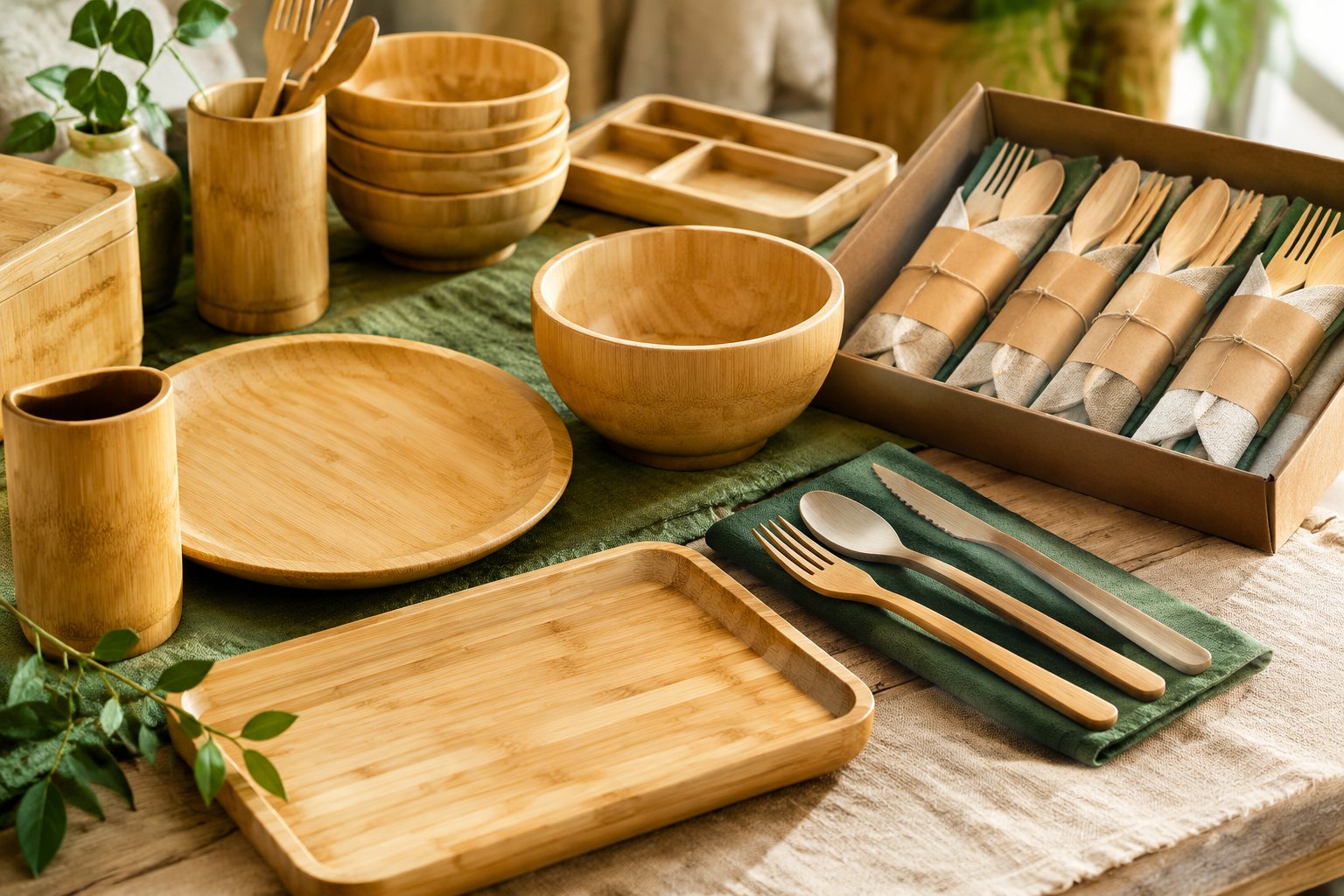
The line runs deeper than fork, knife, spoon. Current stock shapes cover:
- Cutlery: forks, knives, spoons and the spork, in lengths suited to takeaway portions.
- Tasting spoons: short spoons for sampling, deli counters and tasting events.
- Straws and stirrers: for bars, cafes and cold-drink programs.
- Skewers: for grilling programs and passed appetizers.
- Plates: bamboo plates in a range of diameters, for catering and event service.
- Kits: napkin-wrapped cutlery kits, counted and sealed for one-hand distribution.
- Case packs: cartons packed to a fixed count so receiving and par-stock math work.
Stock shapes exist because tooling already does; they are where programs start. Custom shapes and custom prints are quotable, sit above stock on the reference MOQ, and add sample rounds. Palm-fiber style plates are a different material with its own supply chain; if a brief calls for them we say so plainly and quote them as what they are, not as bamboo.
Compostability is a program document, not a claim
This is the part that separates a durable program from an embarrassing one. Compostability is a tested, certified property of one specific product from one specific producer. The schemes buyers meet in North America and Europe are BPI certification for North America, the ASTM D6400 standard specification in the US, EN 13432 in Europe, and the TUV OK Compost family of marks. A certificate belongs to the product, is listed publicly by the scheme, and can be checked by anyone with the certificate number.
So the working rule at this desk: when your packaging must say a product is compostable, we quote against items whose certificate references verify on the scheme's lookup, and the references are written into the quotation and the program file. Until that paper exists for your exact item, the honest language is made of bamboo, with the certification question answered by the document when it arrives. The compliance and certifications page explains each scheme and who holds the certificate.
Channels and how they buy
Foodservice distributors buy on case counts: units per case, cases per layer, cases per pallet, and a certificate file their own customers can audit. Events and wedding suppliers buy smaller, presentation-led quantities, often as wrapped kits paired with a plate, and their paperwork burden is lighter unless a municipality requires certification. Takeout and delivery programs buy wrapped kits sized to the bag, and care about kit contents as much as the fork itself, because a missing napkin is a support ticket. Each channel pulls a different mix from the same line, which is why the brief asks for the channel before the item list.
MOQ and lead time, as reference ranges
Published figures for this route are reference ranges, confirmed in writing for each program. Disposable bamboo cutlery typically starts from about 1,000 pieces per item, usually packed per case; custom shapes and custom prints sit higher than stock. Stock samples typically ship within days, and custom samples take about 7 to 15 working days. Bulk production typically runs 30 to 45 days after sample approval. Certification testing, printing and packaging choices all move these numbers, and the MOQ and lead time page explains how.
What we check before quoting
Before a disposable program is quoted, the desk fixes five things in the program file. Species and harvest-country data, because bamboo is a plant product and US formal entries under HTSUS Chapter 44 carry a Lacey Act declaration prepared from these fields. Finish status, since disposable items run either unfinished or with a food-safe light finish per program. Kit composition, counted to the piece, including napkin spec. Certificate references for any compostable claim, verified on the scheme lookup. And packaging specification, because case count and carton marks are part of what a distributor actually buys. The disposable cutlery guide and the disposable dinnerware guide cover the item-level detail.
Storage and handling on your side
Disposables are dry goods with a low drama threshold, but two habits protect a program. Keep cartons off concrete and away from wet zones, because bamboo is hygroscopic and a damp storeroom shows up later as warping or odor complaints. Rotate by case date the way any foodservice dry good is rotated, oldest stock to the line first. Wrapped kits add one more rule: store them flat and sealed until service, because a kit opened and re-taped is a kit that counts wrong at the register. None of this is exotic, and all of it can go on the spec sheet as storage guidance, so your operations team and the workshop work from the same handling language from the first carton onward.
Stock first, custom second
The route rewards sequencing. A stock fork with the right certificate reference and the right case pack beats a custom silhouette on every operational measure: it samples in days, it runs on existing tooling, it sits at the reference MOQ, and its paperwork already exists in a file somewhere. Custom shapes earn their keep when a brand look demands it, an event format needs a specific plate diameter, or a kit configuration is genuinely novel. Even then, the efficient pattern is a stock platform with custom packaging, moving to custom tooling only once volumes justify it. We will say so plainly when a brief asks for custom work the channel will not pay for, because the desk's interest is programs that reorder, not programs that launch once and stall.
If your program needs a specific certificate before it can launch, say so in the brief. Matching items to existing certificates is faster and cheaper than certifying a new shape, and we will tell you which of the two your program is facing. Send the brief and the route becomes a checklist.