
Sets are a merchandising decision first
A single bamboo fork is a product. A bamboo cutlery set is a proposition: it tells the shopper what the pieces are for, where they live, and whether the brand thought the moment through. That is why this desk treats set composition as its own conversation with the partner workshop, separate from the cutlery itself. The pieces may come off the same production line, but the pouch, box and piece logic decide whether the set sells at the price point you have in mind.
Wholesale buyers feel this quickly. Retail buyers ask what the opening set looks like. Corporate gift buyers ask what the box says before they ask what is inside it. Program buyers for canteens and hospitality ask the opposite question: how few pieces can a kit carry and still count as complete. The three formats below answer all three audiences without pretending one format serves them all.
The three formats this desk quotes
| Format | What is inside | Where it sells |
|---|---|---|
| Three-piece basics | Fork, knife and spoon, bare-sanded or oiled, banded or sleeved | Retail shelves, canteen and reuse programs |
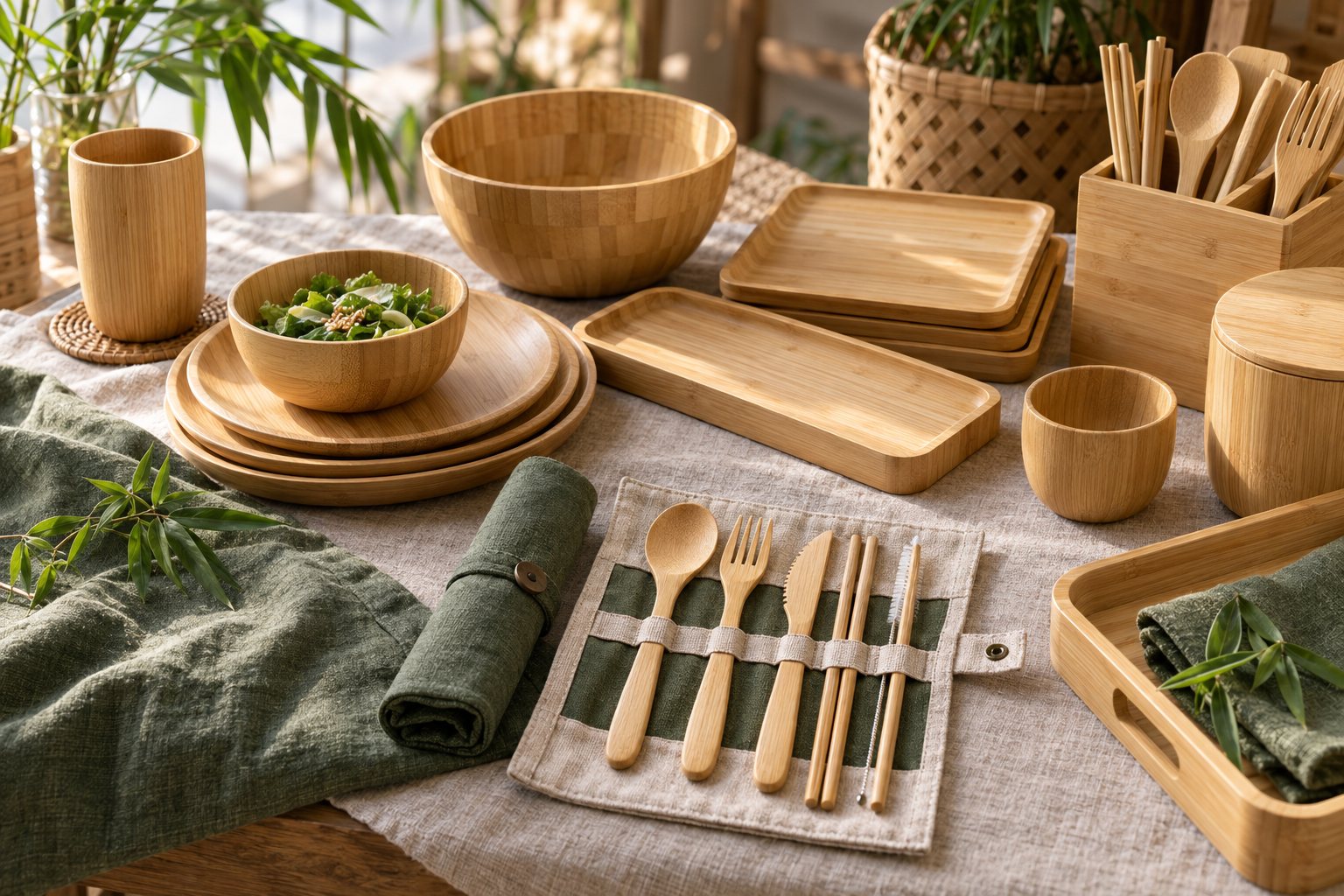
| Pouch and travel sets | Pieces plus a cotton or woven pouch with a fold or zip closure | E-commerce, on-the-go retail, event welcome kits |
| Boxed gift sets | Pieces plus a presentation box, insert and engraving space | Corporate gifts, weddings, seasonal gifting |
The basics set is the workhorse of the category: it holds an opening retail price point, ships flat, and gives a reuse program something people actually keep in a desk drawer. Pouch sets carry the story further, because the pouch is itself a branded surface and the set travels in a bag or glovebox. Boxed sets sit at the top, where the unboxing moment is part of the product. Most brands start with one format and add the second once the reorder rhythm is established.
Set composition logic
Piece choice follows use case. A lunch kit leans on the spork to keep the set light; a table set wants the classic fork, knife and spoon. Some programs add a second spoon for dessert service, or carry a four-piece layout with a spork alongside the trio. There is no universal answer, and inventing one would only show up later as stock that does not move. Composition is written on the spec sheet per style, and each configuration counts as its own style for planning, which is also how the workshop schedules it.
Composition extends to what rides along: a care card, a napkin band, a small printed insert. These are cheap lines on a spec sheet and expensive omissions afterwards, because they are the pieces that answer the buyer's questions before support has to.
A word on hybrid constructions
Hybrid sets that pair stainless-steel handles with bamboo accents exist in the wider market, and some shoppers like the weight. They are a different construction with a different supply chain behind them. This desk sources bamboo-handled sets: whole bamboo shaped from the culm and finished as described on the reusable cutlery page. If a program explicitly wants a mixed-material item, it is quoted as exactly that, with the material system named on the spec sheet, rather than presented as bamboo. Naming the material is what keeps your product page honest and your compliance file short.
Quality signals to demand in a set
Sets are judged as one object, so inconsistencies that a single piece would hide show up in a box of three. Sanding should feel identical across fork, knife and spoon; tone should match, since buyers read color drift as a defect; and the pouch stitching or box fit should take the same care as the pieces, because that is where the hand meets the product first. We add these lines to the inspection list per program, alongside the standard smoothness, moisture and crack checks, so the set arrives as one design decision rather than three pieces and an afterthought. None of this adds much cost; all of it adds back goodwill.
How MOQ works for sets
Durable styles typically run 500-1,000 pieces per style as a reference range, and each set configuration is a style: a three-piece oiled set and its spork variant are planned separately, and so are pouch colorways if a program runs more than one. A pouch adds a second supply step, since pouches are sewn or woven separately from the cutlery and then kitted together, which lengthens the timeline modestly and adds one more line to the spec sheet. Boxed sets behave the same way around the box. All figures are confirmed in writing for the program; the reference ranges sit on the MOQ and lead time page.
Packaging and branding on sets
Sets carry more brand surface than single pieces: the band, the pouch, the box sleeve, the care card. Laser engraving on the pieces and print on the packaging are quoted together so the look lands as one design instead of two vendors guessing at the same green. Artwork for pouches and sleeves follows the print guidelines on the private label page, and the carry formats get a fuller treatment in the buyer note on cutlery pouch sets.
Who buys sets, and what they reorder
E-commerce sellers open with pouch sets because they ship flat, photograph well and answer the on-the-go use case in one look. Boutiques lean toward boxed sets at gifting seasons; the seasonal logic is laid out in the buyer note on bamboo gift set programs. Canteen and workplace programs order the basics set in volume for reuse schemes, and corporate gift buyers come back annually, which makes the second-order conversation the real test of the first specification. When you know the channel, the set almost designs itself; when you do not, start from the use moment and work backwards. Send the desk the moment, and we will come back with two or three compositions to choose from, each with its reference MOQ in writing.