
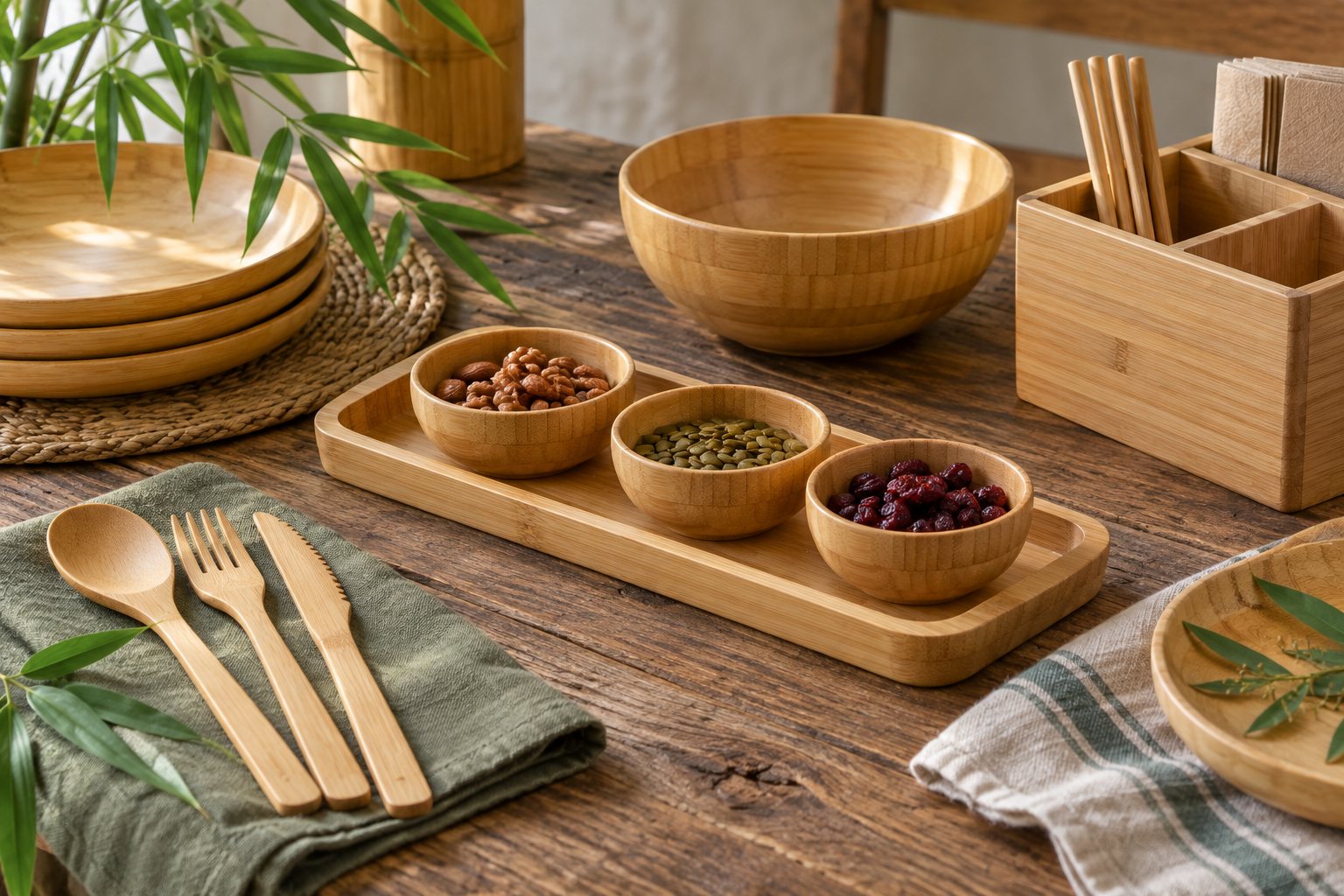
What counts as serveware
Three pieces carry most serveware programs: serving trays, platters and boards. They share laminated-panel construction, they take engraving well, and they live in two channels at once, which is unusual in this category. A tray sells in a boutique as a gift and in a hotel as equipment; a board sells to a home cook and to a caterer. Programs that plan for both channels from the start avoid the redesign that hits brands who discover the second market two seasons late.
| Piece | Typical construction | Where it earns its place |
|---|---|---|
| Serving tray | Laminated panel with cut-out or fixed handles | Breakfast service, retail display, gifting |
| Platter | Pressed oval or rectangular forms | Catering, table service, food photography |
| Serving and cutting boards | Laminated or edge-grain panels | Cheese and bread service; some double as working boards |
Construction is mostly laminated panels for a reason: flat, stable surfaces at serving sizes need the width a single culm section cannot give, and the pressed panel takes handles, cut-outs and edge profiles cleanly. Where a design wants curvature or a thicker feel, shaping and panel building combine, and thickness becomes a spec line. The adhesive system behind the panel is named per item with its food-contact papers, exactly as on the dinnerware side.
Engraving and presentation surfaces
Serveware offers the largest flat branding surfaces in the durable line, which is why it anchors gift programs: a platter with an engraved mark is kept, displayed and photographed in a way smaller pieces are not. Placement runs along an edge or on the face; depth and artwork are approved on a sample, and silk-screen printing is available where a color mark matters. Presentation boxes pair naturally with this tier, and the packaging is quoted together with the piece so the set arrives as one design.
Retail display: the piece that sells other pieces
Boutiques and home stores merchandise on bamboo trays and boards as much as they sell them: the flat, warm-toned surfaces group products, and shoppers buy the stage as often as the actors. That is why serveware carries retail packaging well, and why engraving sells: a mark on a tray is visible daily in a way a mark on a box never is. The merchandising angle is worked through in the buyer note on bamboo serveware and platters for retail, including how seasonal programs use platters as the seasonal hook.
Hospitality: rotation, stacking and replacement
Hotels, cafes and caterers buy serveware as equipment, which changes the questions: how pieces nest for storage, how they survive a washing routine, how replacement stock arrives on a cadence rather than as one bulk drop. Panels and edge shaping decide stacking; the finish system decides how the pieces age in commercial service; and the reorder plan decides whether a venue ever runs short mid-season. The venue channel and its buying pattern are described in the buyer note on the restaurant and hospitality channel, and the desk prices replacement cadence into the program rather than treating it as an afterthought.
Three spec lines matter before looks do: stacking height for storage, handle or cut-out strength for carrying a loaded tray, and edge shaping so hands and tablecloths survive service. A venue will forgive a plain look long before it forgives a tray that racks badly, so these lines go on the spec sheet first and tone is the second conversation.
Care that keeps the tone
Serveware ages in public, so the care line matters commercially, not just technically. Standard practice: hand wash and dry, avoid soaking, re-oil occasionally for oiled finishes. Water is the enemy; the failure mode buyers should watch for is surface dulling and, in neglected cases, staining, which is why the care card earns its place in the box. Prolonged damp is also the condition behind mold questions in any natural-fiber product, and the prevention checklist sits in the buyer note on mold prevention in bamboo products. None of this is exotic; it is the same discipline that keeps a wooden spoon in service for years.
Re-oiling is also the easy maintenance win: a few minutes with a food-contact oil restores tone on oiled finishes before a service season or a photography shoot. Programs that tuck a short care instruction card into every box see fewer aging complaints; the card is one printed line item and it does the work of a support ticket that never happens.
Sizes, shapes and customization
Tray and platter dimensions run as common options, confirmed on the spec sheet per program, and most programs start there before commissioning a custom shape. Custom silhouettes sit higher than stock on the reference MOQ and take a sampling round, which is the honest price of a shape nobody else carries. The production steps behind both paths, from panel pressing through sanding and finishing, are described on the production process page, so a buyer can see where a custom curve adds cost and where it only adds time.
Where serveware sits in a line
As a second tier, serveware attaches cleanly to dinnerware: same care card, same material story, higher ticket. As a first tier, it works for gift-led brands and venues, with everyday pieces following later. Either way the spec discipline is identical, which is what makes the tier low-risk to add and easy to reorder once the first style proves itself.
How serveware programs are quoted
Durable styles typically run 500-1,000 pieces per style as a reference range, confirmed in writing for each program, and boards that double as cutting surfaces carry an extra spec line about knife-scar expectations and finish. Where a program sits between serving-only boards and working boards is a use question, and the comparison with wooden boards is laid out honestly in the buyer note on bamboo cutting boards versus wood. When the pieces and channels are decided, send the brief to the desk; the reply will name a route, a sampling plan and the reference ranges in writing, with lead time planning on the MOQ and lead time page.