
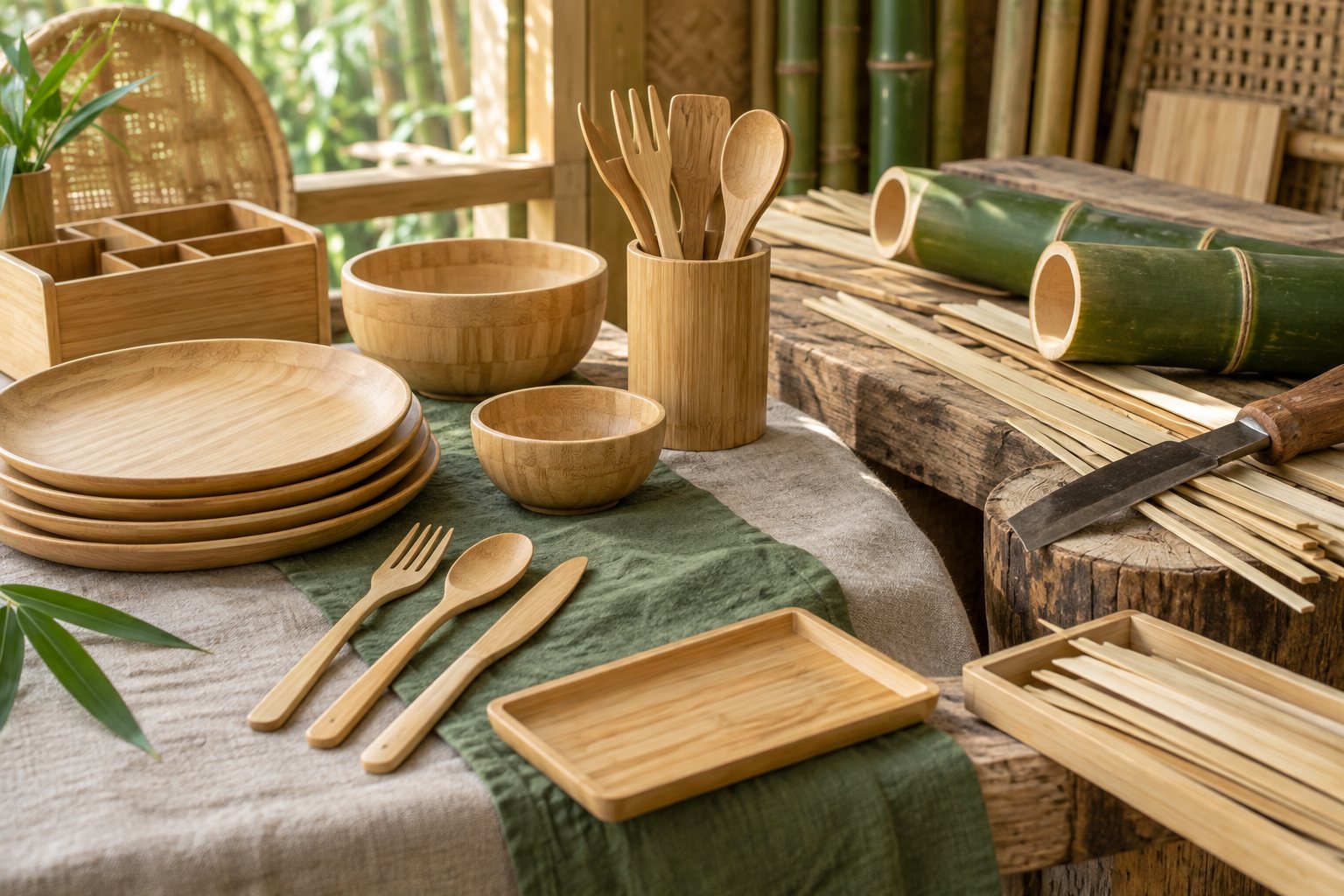
One raw material, two process stories
Buyers who understand process write better briefs, catch spec errors earlier and audit reports meaningfully. The good news is that bamboo tableware has only two process stories to learn. Both start at the same place, a mature moso culm selected from managed groves, and both end at a packed carton. Everything in between differs by route, and the differences are exactly where quality is won or lost.
Story one: the disposable route
Disposable bamboo cutlery and plates are shaped directly from the culm, and the process is a chain of subtractions. Mature culms are selected by age and diameter, because immature material behaves poorly in later steps. The culms are split into strips, and the strips are cut or pressed into shapes: fork tines, spoon bowls, plate diameters. Shapes are sanded smooth, which is not cosmetic; a splinter on a disposable fork is a complaint, a return and a channel problem in one. The shaped items are cleaned and sterilized, then counted and case-packed, because the foodservice buyer's unit of account is the case, not the piece.
Finishing on this route is deliberately minimal: either no finish at all or a food-safe light finish, per program. That choice is written into the spec because it affects the compostability paperwork story and the feel of the product in the hand. The chain looks simple and is; its difficulty is repetition. A case pack is judged at the thousand-case mark, so the process is built for consistency across runs rather than craftsmanship in one. That is also why dimensional consistency is the checkpoint most worth agreeing in writing: everything downstream, from kit wrapping to carton fill, assumes it. The full item-level detail sits on the compostable disposables line page, and the culm-to-case-pack guide follows one fork through every step.
Story two: the durable route
Durable bamboo ware starts from the same groves but builds instead of subtracting. Strips and panels are laminated, strips pressed with adhesive into panels, or items are shaped from whole bamboo, depending on the object: flat plates, trays and organizers come from laminated panels; cutlery and boards often from shaped whole culms. Panels and shapes are machined, then sanded through progressively finer grits until the surface reads as finished rather than merely smooth. The food-contact oil finish is applied, giving the surface its depth and its renewable quality, since users can re-oil over the item's life. Branding follows: laser engraving for permanent marks, silkscreen for contrast marks. Quality checks run on smoothness, moisture and cracks, and the items are packed, often into branded sleeves or boxes where the program calls for them.
The adhesive in laminated panels is a specification line, not an afterthought, and its documentation is part of the program file. The durable bamboo ware line page covers the material systems and finishes in depth.
Where the two stories actually differ
The divergences are worth naming because they drive the paperwork. Disposables carry almost no applied chemistry, which is why their compostability conversation is about the item itself and its certificate, while durables carry an oil and, on laminated items, an adhesive, which is why their conversation is about named systems and attached papers. Disposables are counted, because their unit of trade is the case; durables are inspected piece by piece on finish and branding, because their unit of trade is the shelf. And the routes differ in tolerance for moisture: a disposable fork is used within hours of unwrapping, while a serving board lives in a kitchen for years, so the moisture level at packing and the drying discipline before it are stricter on the durable line. A buyer who keeps these three divergences in mind can usually predict which document a program will need next.
Checkpoints between the stages
| Stage | What is checked | Why it matters to a buyer |
|---|---|---|
| Culm selection | Maturity, diameter, condition | Downstream strength and crack behavior start here |
| Splitting and shaping | Dimensional consistency against the spec | Case-pack fit and kit assembly depend on it |
| Sanding | Smoothness, no splinters or raised grain | Hand feel is the product on both routes |
| Sterilizing (disposables) | Cleanliness of finished pieces | Food-contact readiness at unpacking |
| Laminating (durables) | Adhesive system as documented | Papers must match the product at audit |
| Oiling and branding | Finish coverage, mark position and depth | Golden sample governs the bulk run |
Checkpoint sets are agreed per program in writing, not inherited blindly. A wedding kit program cares most about counting and wrap; a retail cutlery set cares most about engraving and pouch fit; a foodservice case pack cares most about dimensional consistency. The quality control page explains how these become inspection criteria.
Why process literacy pays
Three practical payoffs justify the reading. First, sampling: a buyer who knows that sanding grit progression drives hand feel can compare samples on the right axis, not just color. Second, MOQ and lead time: knowing that custom shapes add tooling and sample rounds, while stock shapes run from existing tooling, explains why the reference ranges differ and what your customization actually costs in time. Third, reporting: inspection reports are only useful if you know what a moisture or crack check means for your channel, which is why the desk walks buyers through the first report line by line. A fourth payoff is negotiation quality: buyers who know which step their customization touches can see why it moves the range, and ask better questions about it.
For a concrete read, the bamboo cutlery hub ties process detail to specific items. If you want the process story for your own brief, send it over and the reply will map each stage to your item list, with checkpoints proposed in writing.