
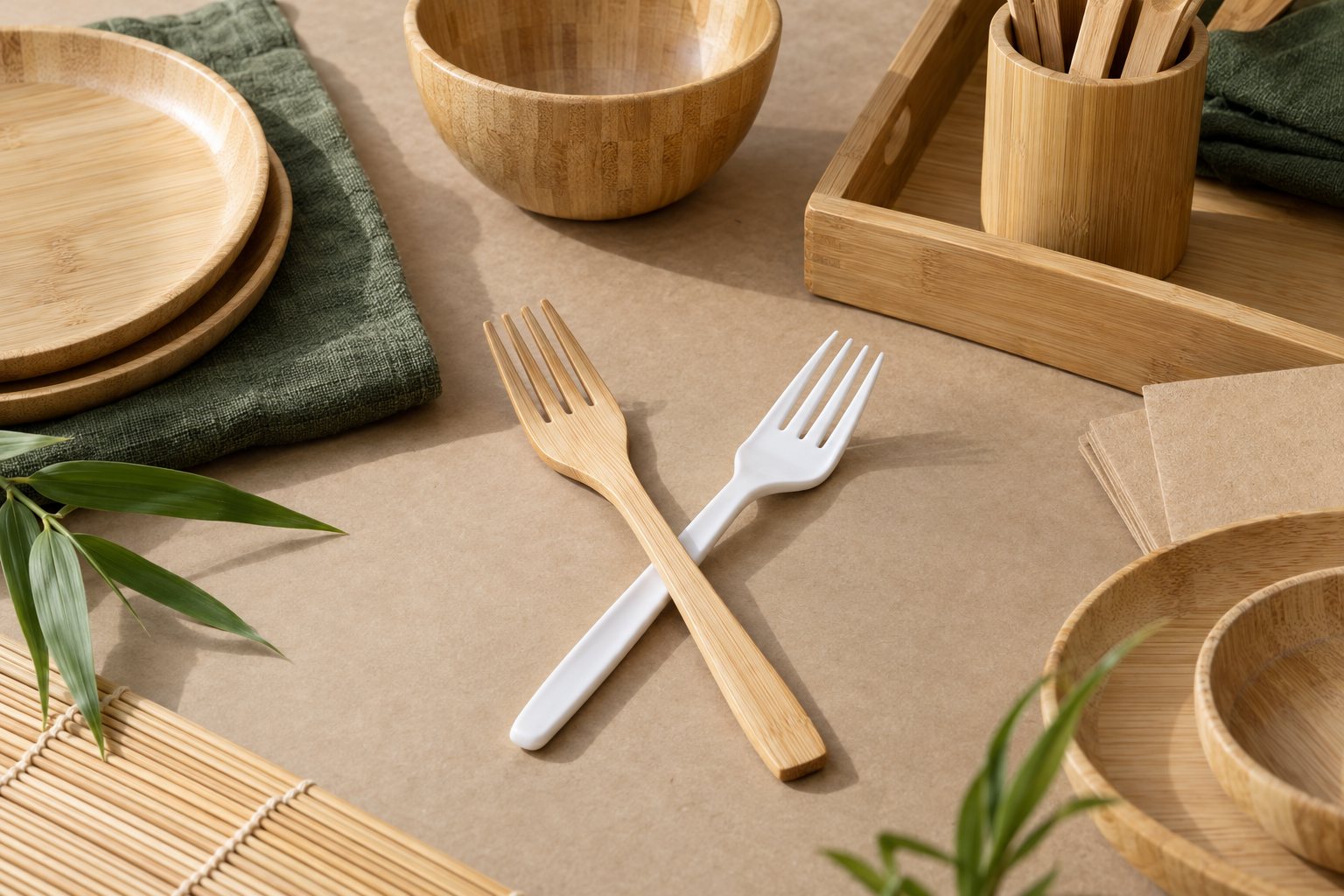
The comparison buyers actually need
Most bamboo vs plastic cutlery content online is a verdict in search of a question. A sourcing decision needs the opposite: a quiet walk through origin, end-of-life claims, cost and channel fit, ending in a choice you can defend to a customer, a regulator and your own finance team. That is what follows — including the places where plastic is still the right answer.
Where the material comes from
Bamboo cutlery starts as moso bamboo, a grass that regrows from its root system after harvest without replanting, processed in China's established bamboo belts — Zhejiang and Fujian among them, where the industry is concentrated enough that government and industry reporting describes thousands of enterprises and an initiative to substitute bamboo for plastics in categories that include tableware. The supply story is agricultural and renewable in the everyday sense of the word.
Conventional plastic cutlery is fossil-derived, molded in a few grams of polymer per piece. CPLA — crystallized polylactic acid — is the third contender: a bio-based plastic made from plant sugars, heat-treated for rigidity, and a common choice where a compostable-claim plastic is wanted. Origin, then, reads: renewable grass, fossil polymer, bio-based polymer. The origin story matters to buyers because it is the part of the comparison your customers can verify with a search — and because it feeds the end-of-life question, which is where the paperwork lives.
End of life: certificates decide, not adjectives
End of life is where this comparison is usually argued badly, so here is the disciplined version. A compostability claim is a certified property of a specific product: certification under schemes such as BPI, ASTM D6400 or EN 13432, verified through the scheme's public lookup, held by the product and its producer. Where a bamboo cutlery program holds those documents, the claim exists and is quotable with its reference; where it does not, the honest packaging language is "made of bamboo", and the item's afterlife depends on local organic-waste acceptance — a question for your waste partner, answered with documents.
Plastic cutlery's end-of-life story is the recycling stream, and the practical reality that most municipal streams do not want small rigid plastics of any description. CPLA is designed for industrial composting and is often certified to the same standards — but acceptance is facility-by-facility, and a certification on a CPLA fork does not ensure your city's composter takes it. Nobody in this comparison gets a free pass; everybody needs the certificate. Our compliance page collects the claim rules, and the disposable bamboo cutlery page shows the document flow in a real program.
Cost positioning, honestly
Bamboo disposables generally sit above commodity plastic cutlery on unit cost — the material is agricultural, the pieces are cut and finished rather than flash-molded, and per-program quotes reflect item, wrap and packaging choices. Against CPLA, bamboo is often comparable, sometimes above and sometimes below depending on the piece and the program; there is no standing answer and we do not pretend to one. The useful cost question is not unit price but program price: a wrapped kit, a case pack, a claims file and a reorder cadence cost money in every material, and the differences between materials shrink or grow depending on how much of that program your channel actually needs. Quotes are per program — route, item, print, packaging and certification needs — never from a fixed list.
Where plastic still wins
An honest comparison says this plainly. Plastic wins on uniformity: a molded fork is identical to the million before it, while bamboo varies in tone and grain within any shipment — usually read as character, occasionally read as a defect by customers expecting machined perfection. Plastic wins on stated heat tolerance: polymer makers publish temperature specs for their resins, whereas natural-material heat positions are per-program and more conservative in what we will write on a spec sheet. And plastic wins on floor cost in channels where nothing but the lowest input price matters and no claim is needed. If your program is a high-volume, claim-free, uniformity-driven operation, plastic may be the right tool; the case for bamboo is built on the channels below.
Running the comparison inside a live program
The comparison earns its keep when it is run on your actual program, not on principles. The sequence we walk with buyers:
- Fix the claims list. What the packaging must say — this decides whether certificates are needed at all.
- Fix the format. Wrapped kit or open bulk, case count, carton size.
- Quote both materials on the same format. Same item list, same wrap, same documentation asks.
- Test locally. Confirm what your waste partners accept and what your customers experience.
- Decide per channel. One material per program is cleaner than a split, unless volumes argue otherwise.
Buyers who run this sequence usually find the decision obvious by step three, because the format — more than the material — drives program cost. The material choice then rides on claims and story, which is where it belonged all along.
Channel fit: where each material belongs
| Channel | What usually fits | Why |
|---|---|---|
| Regulated takeout markets | Bamboo or certified CPLA | Single-use plastic rules in various jurisdictions are reshaping cutlery choices — verify local requirements |
| Events and weddings | Bamboo | Tone, grain and the unwrapped-table aesthetic; plastic reads as canteen |
| Zero-waste retail | Bamboo | The story and the material match the shopper |
| High-volume contracts | Decide per claims file | Uniformity and input cost pull one way, documentation requirements pull the other |
For the natural-versus-natural version of this comparison, continue to bamboo vs wood cutlery; for a worked buyer's view, see the extended comparison and bamboo vs CPLA.
If you have both quotes on your desk and need a structured way to choose, send us the item list and the channel — we will tell you where bamboo fits, where it does not, and what each program would need in writing.