
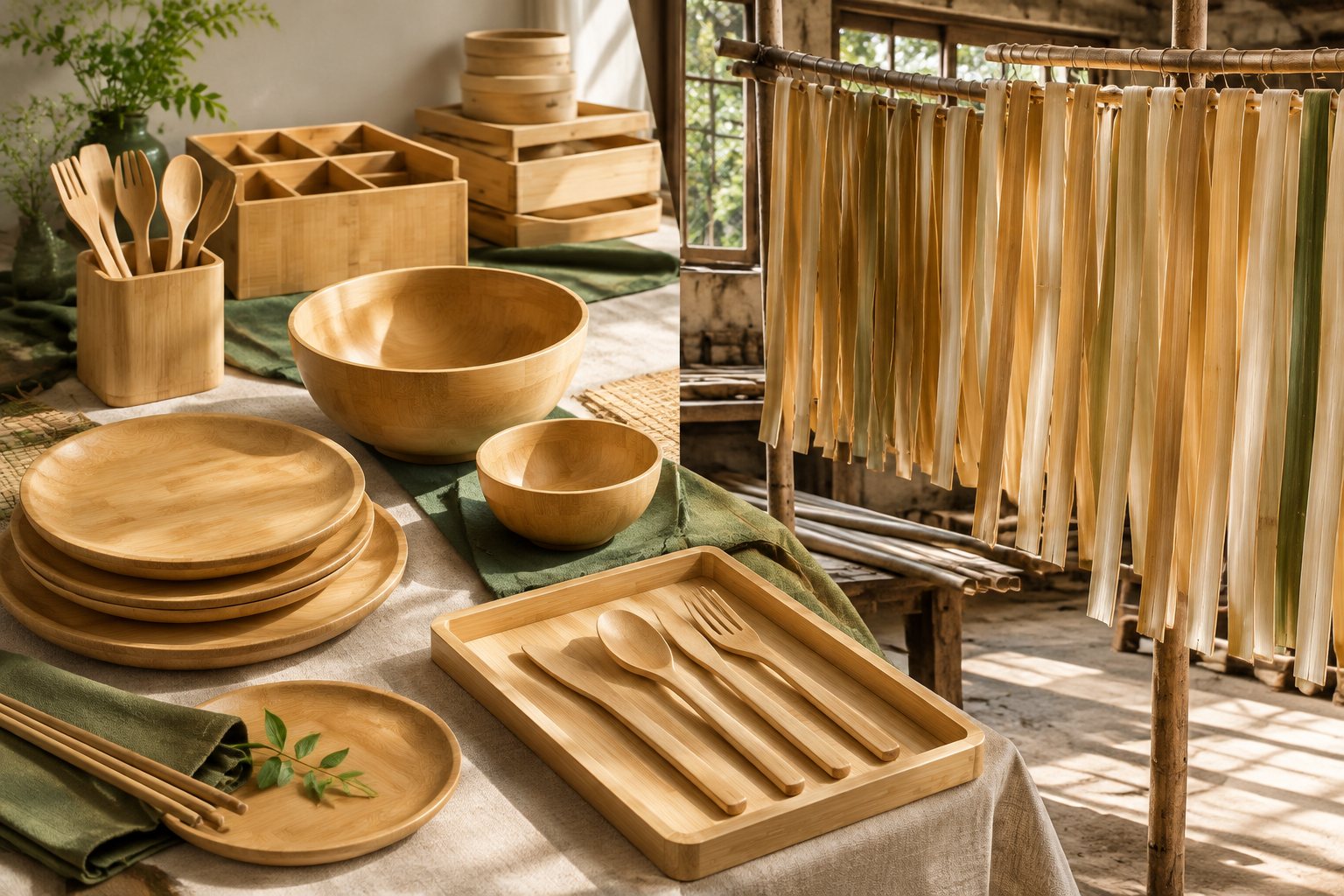
Why the belts exist at all
Bamboo tableware does not come from everywhere evenly. It comes from belts where raw material, processing tradition and government policy line up. The policy line matters more than most buyers realize: in 2022 China launched the bamboo as a substitute for plastic initiative together with the International Bamboo and Rattan Organization (INBAR), and the National Development and Reform Commission's action plan lists tableware among the priority replacement categories. Multiple provinces carry local support policies on top. For a buyer, this backdrop is not trivia; it explains why capacity for disposable and durable bamboo ware has been expanding in specific places, and why a desk rooted in those places can match programs to workshops faster than a generalist agent.
The belts themselves
Zhejiang is anchored by Anji, widely described as a bamboo county, which also runs a bamboo replacing plastic pilot in hospitality settings, meaning hotels and venues substituting bamboo items for plastic ones as a policy demonstration. Fujian is anchored by Nanping, where forestry authorities describe a one core, two belts full-chain bamboo industry layout: groves, primary processing and finished-goods workshops planned as one chain rather than scattered trades. Hunan and Sichuan carry additional bamboo belts. Canegrove's operations office sits in Yongjia, Wenzhou, in Zhejiang, which is a coordination location, not a production site; the workshops we coordinate sit inside the belts where the material and the tooling live.
What the scale numbers say, with attribution
The industry scale is large enough to matter and should always be quoted with its source. Government and industry reporting put national bamboo industry output at more than RMB 500 billion in 2024, bamboo products import and export trade at about USD 2.3 billion, and the number of bamboo processing enterprises at more than 10,000. Those figures say two things to a buyer. First, this is a real industrial base with depth, not a craft scene. Second, the base is fragmented: more than ten thousand enterprises means thousands of small and mid-size workshops, and quality varies between them exactly as you would expect. Reported figures also get revised as the industry grows, which is another reason they are quoted with their source and year rather than memorized. The numbers do not tell you which workshop is right for your program; verification does.
How the desk verifies workshops
Verification is the desk's core work, and it is deliberately boring. A workshop enters the network only after its profile is checked: what it actually produces, with what tooling, under which certifications it already holds for existing products, what its raw material supply looks like, and what its documentation practice is, meaning whether it can name the adhesive system in a laminated panel and the finish on an oiled board, with papers. We check rather than assume because the difference between a catalog claim and a workshop capability is where programs fail. The quality control page describes the checks that run during production; this page is about the checks that happen before a workshop is even offered to you.
Capability fields are always stated as to be provided per workshop profile. We do not publish invented staff counts or output figures for individual workshops, and we advise against accepting such figures from suppliers without documentation, because decorated numbers are a known hazard in sourcing generally.
Reading a workshop profile
Since capability fields are stated as to be provided per workshop profile, it helps to know what a profile actually contains. The productive fields are concrete: the product families the workshop runs today, the tooling behind them, the certificate references it already holds for existing items, its raw material arrangement within the belt, and its documentation practice, meaning whether adhesive and finish papers arrive attached to the goods or on request, if at all. Just as telling are the soft flags. A workshop that quotes every capability on first contact usually has none verified; one that answers a material-system question with a document rather than an adjective is the one that survives an audit. Profiles are revisited between programs, because tooling, certificates and material arrangements change; a workshop matched last season is re-checked before it is matched again. The desk's verification is essentially the discipline of asking these questions before your money is at stake instead of after, and writing the answers into the profile your program is matched against.
The material underneath the belts
Moso bamboo is the mainstream species for tableware, and it is the reason the belts sit where they sit. Bamboo regrows from its root system after harvest without replanting, which shapes both the supply rhythm and the material story a buyer can tell honestly. The species and harvest-country data are also entry data: bamboo is a plant product, and US formal entries under HTSUS Chapter 44 carry a Lacey Act declaration built from these fields. The moso sourcing guide covers the material, and the supply chain guide follows it from grove to carton.
What this means for your program
Practically, the network structure gives a buyer three advantages when the desk is used properly. Route matching: disposable and durable programs need different tooling and different paperwork, and the belts contain workshops for each, so the route decision comes first and the workshop match follows. Paperwork depth: workshops that already serve certified programs have certificate references that verify on scheme lookups, which is the only honest basis for compostable claims. Consolidation: because the belts overlap geographically, mixed programs can share shipments. The wholesale buying guide shows how buyers use this in practice, and the about page explains how the desk operates.
If your program needs a specific capability, certificate status or material story, send the brief and the workshop match, with its profile, comes back with the quotation.