
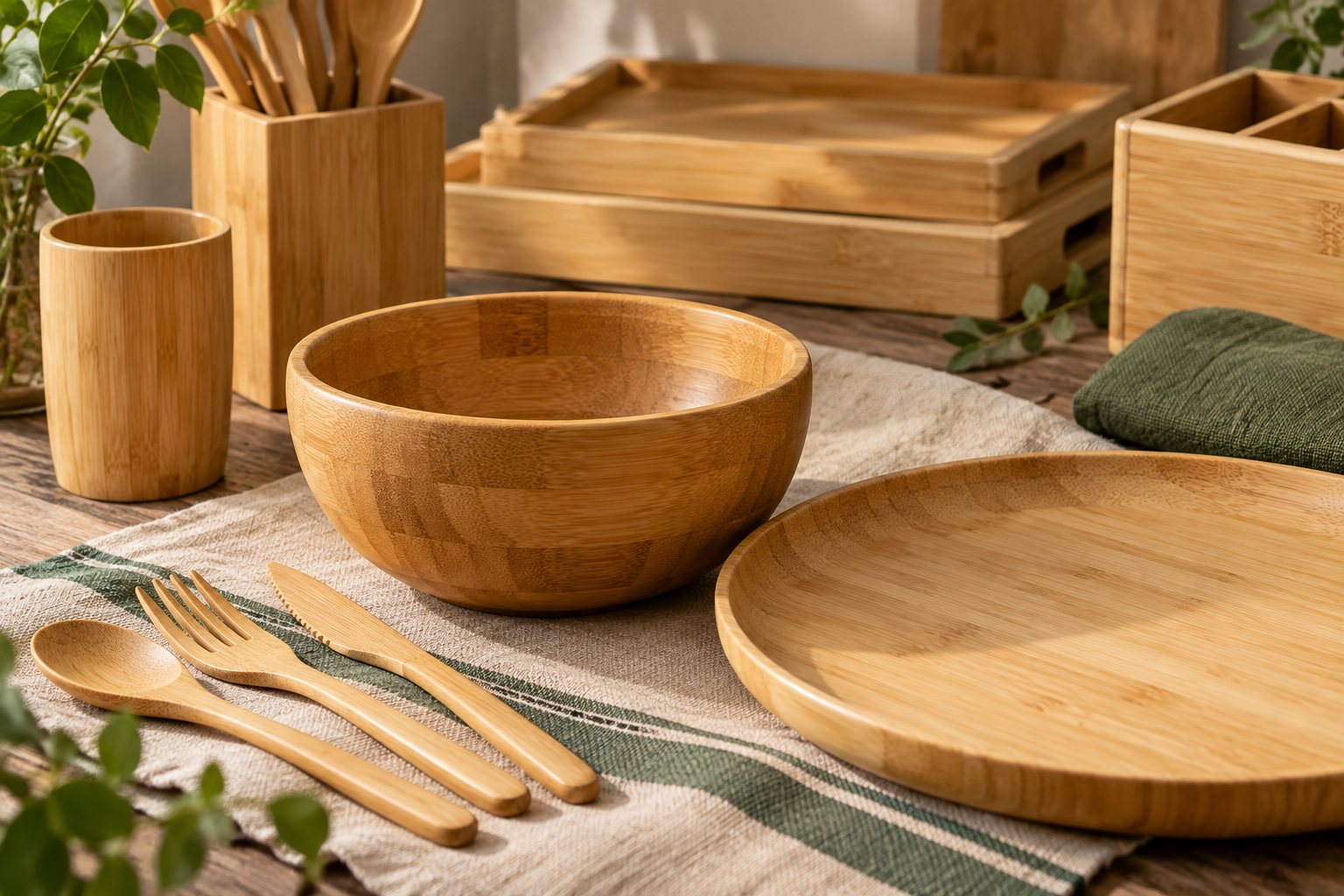
Where the durable route earns its keep
Durable bamboo ware competes on a retail shelf, and the shelf is unforgiving about two things: how the object feels in the hand, and whether the packaging says something provable. A bamboo tableware set that looks right but lacks finish paperwork fails at the retail audit; one that feels rough fails at the shelf itself. So this route is specified differently from disposables: the material system, the finish, the branding method and the care instructions are all named in writing before a sample is approved, because each of them is a claim a retailer or marketplace will eventually ask about.
Two materials, one honest label
Whole bamboo is cut from the culm and shaped: cutlery, boards, and round or oval items that follow the natural form. Laminated bamboo is strips pressed with adhesive into panels, then machined into flat and pressed items: dinner plates, trays, organizers, much serveware. Both are bamboo; they are not the same material in behavior. Laminated panels carry an adhesive system, and that adhesive falls under food-contact rules wherever the surface touches food, so the adhesive documentation is a specification line in every durable program we quote, attached by name to the spec sheet.
One boundary, stated again because it matters commercially: products marketed as bamboo fiber tableware are often melamine resin filled with bamboo powder. That is a different material with regulatory warnings behind it, and it is not part of this route. The dinnerware safety guide shows how to catch the difference on a supplier sheet before it becomes your product page problem.
Finishes: food-contact oil, named and documented
Durable ware is commonly finished with a food-contact oil, renewable by design: the surface can be re-oiled by the user over the life of the item, which is part of the care story rather than a defect. The finish is a named system on the spec sheet, with the workshop's documentation attached, because finishes and adhesives are exactly where claims obligations concentrate, including Proposition 65 assessment for California and the FTC Green Guides for any green language on the box. A buyer approving a sample by feel alone is taking a risk the paperwork is meant to retire; the sample and the document should match on the first look.
Branding: laser, silkscreen, and the packaging layer
The route carries brand well. Laser engraving marks cutlery, boards and organizers permanently and suits natural-toned packaging. Silkscreen suits flat panels and higher-contrast marks. Beyond the object, the branding layer extends to printed sleeves, gift boxes, hang tags and care cards, which is where a private label program actually lives. The private label page covers the methods, the artwork-to-golden-sample flow and the paperwork custom claims require.
Care cards and claim discipline
Durable bamboo is hand wash and dry; it is not a dishwasher or microwave product unless a specific program's spec says otherwise, and the durability of any natural-fiber item depends on its specification. Occasional re-oiling keeps oiled finishes in condition; soaking and damp storage are the enemies. These instructions ship as care cards in the program, and they do double duty as claim discipline: a card that says hand wash is also a promise that the item is not dishwasher-rated, and the FTC Green Guides expect eco language on the box to be qualified and substantiated rather than broad. The compliance page maps which claims need which papers.
The durable line list
| Family | Typical items | Spec attention |
|---|---|---|
| Cutlery sets | Fork, knife, spoon sets with travel pouch; kids' sets | Finish name, engraving, pouch material |
| Dinnerware | Plates, bowls, divided plates, trays, platters | Laminated panel adhesive papers, diameter set |
| Boards | Cutting and serving boards in whole bamboo | Thickness, juice groove, handle style |
| Organizers | Drawer trays, countertop crocks, cutlery trays | Drawer fit dimensions, finish |
| Kids' tableware | Divided plates, bowls, sets marketed to children | CPSIA duties, tracking labels |
| Tea and coffee | Steamers, coasters, trivets | Heat use framing, finish |
Family guides carry the depth: cutlery sets, dinnerware, kids' tableware, travel cutlery, and the serveware and organizer pages for the shelf categories.
How durable ware fails, and what the spec does about it
Durable bamboo rarely fails dramatically; it fails by soaking, dishwashing, or storage in damp, and the failure shows up as raised grain, warping or a dull, thirsty surface. The spec answers each of these in advance. The care card states hand wash and dry and names the exclusion, so the promise on the box matches the behavior of the material. The oil finish is renewable, which converts the one predictable maintenance need into a ritual users can perform with a cloth and food-safe oil, and the care card says so. Fit-critical items such as drawer organizers are dimensioned against stated drawer sizes rather than approximated, because a tray that misses the drawer by a centimeter is a return regardless of how good the finish looks. And packaging keeps the goods dry in transit and on the shelf, because a warped board starts its failure before it is ever unwashed. Kids' items add their own surface questions, which is why the divided-plate spec carries the CPSIA conversation early rather than at the retail audit. None of these lines is complicated; all of them belong in writing, which is where the program file keeps them.
Order sizes and timing, as reference ranges
Durable bamboo ware typically starts at 500 to 1,000 pieces per style, with custom shapes and custom prints above stock levels. Stock samples typically ship within days; custom samples take about 7 to 15 working days. Bulk production typically runs 30 to 45 days after sample approval. All figures are reference ranges confirmed in writing per program on the MOQ and lead time page, and none of them imply a price; pricing is written per program.
If the route fits your shelf, send a brief with the style direction, the claims your packaging must make, and the first-season quantity. The reply names the workshop match, the finish and adhesive papers, and the sample plan.